English
 français
 Español
 русский
 português
 العربية
 tiếng việt
 Türkçe
 ไทย
ไทย Indonesia
Pharmaceutical production demands a different standard of industrial cleaning. The objective is not only to remove visible residue but also to manage fine powder, support housekeeping discipline, redu...
Read More
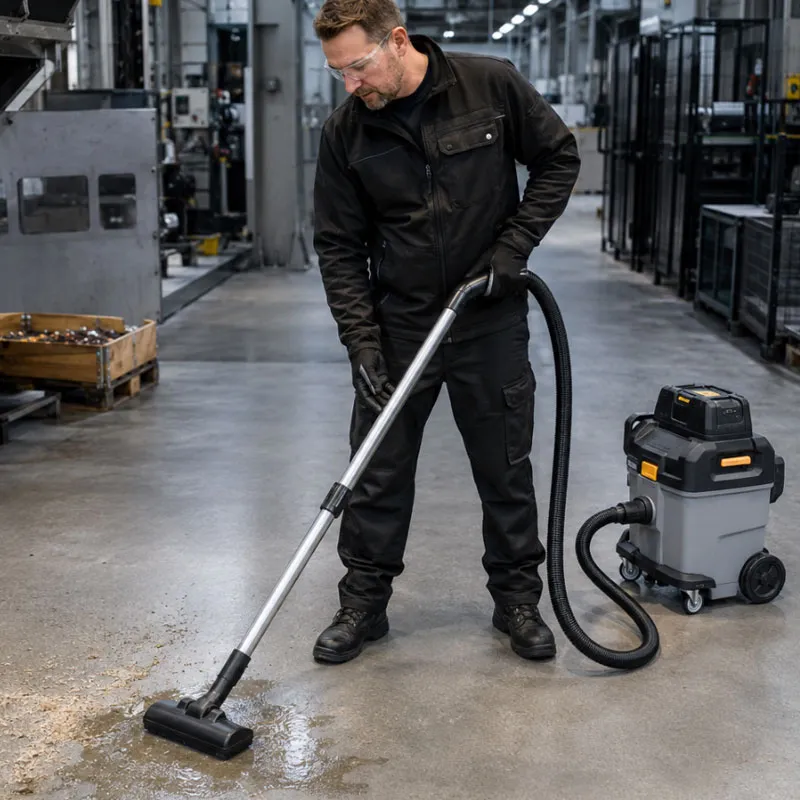
Construction sites, metalworking workshops, woodworking factories, and heavy manufacturing facilities share a cleaning challenge that household and light commercial vacuums were never designed to address. The debris is heavier, the dust is finer and potentially hazardous, the operating environment is rougher, and the cleaning zones are often far from fixed power outlets. A vacuum that cracks under impact, clogs within an hour, runs out of battery before the shift ends, or lacks the filtration to capture fine industrial dust is not just inefficient—it is a liability.
The 2026 industrial cleaning environment adds a layer of regulatory and safety complexity that makes equipment selection more consequential than ever. Stricter workplace expectations around combustible dust—aluminum powder, magnesium dust, wood dust, plastic dust, and fine organic powders—mean that buyers cannot simply choose the most powerful cordless vacuum and assume it is appropriate for every application. The right industrial cordless vacuum cleaner must combine rugged construction, appropriate filtration, battery reliability, and where required, specific safety design for hazardous dust environments.
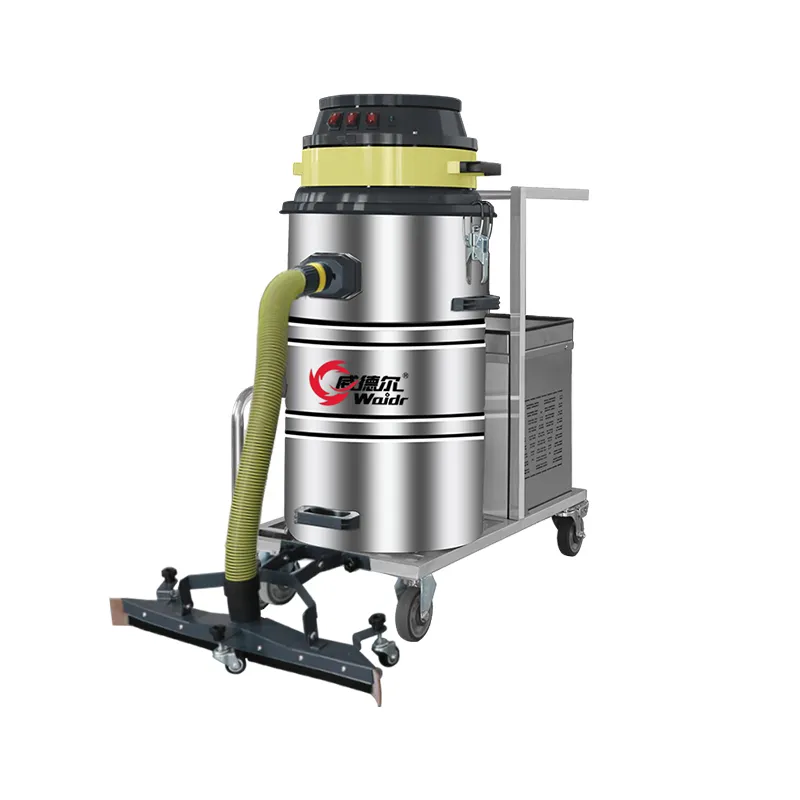
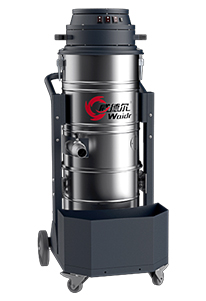
Waidr's WD-100 and WD-100P industrial battery hoover series addresses the general industrial cleaning requirement with a 24V battery platform, 1,500W three-motor system, 100L large-capacity barrel, cyclone separation, washable cone filter, anti-static hose, and thickened stainless-steel body—a specification profile built for demanding workshop, factory, warehouse, and construction site environments.
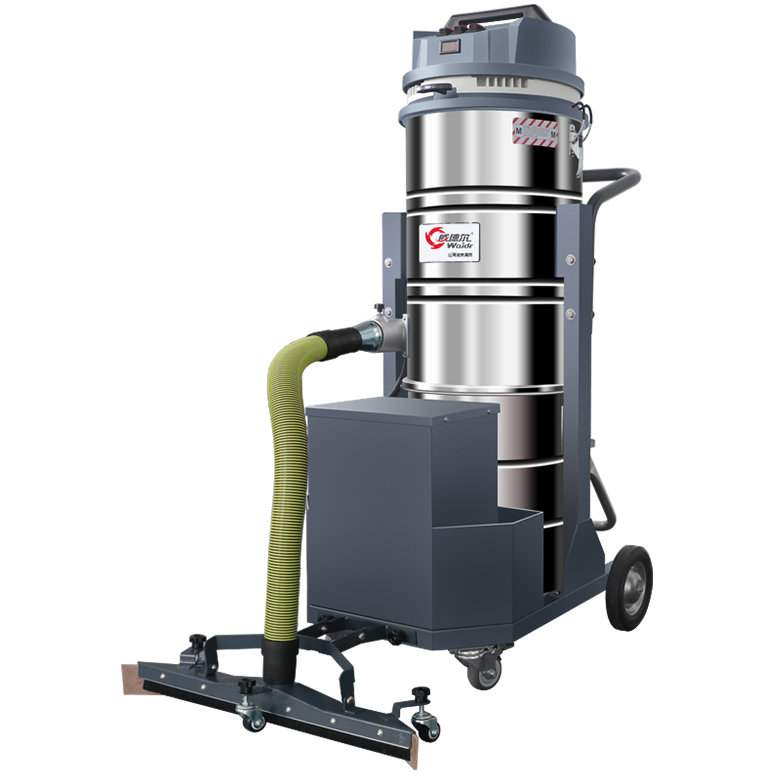
The performance gap between a consumer cordless vacuum and a genuine industrial cordless vacuum is not primarily about suction power—it is about structural durability, filtration capacity, and operational reliability under conditions that consumer equipment was never designed to survive.
The construction and workshop environment demands:
Impact resistance is the first requirement. Industrial vacuums are moved across rough concrete floors, loaded onto vehicles, bumped into machinery, and operated by workers whose primary focus is the cleaning task rather than equipment protection. A plastic housing that cracks on the third day of use on a construction site is not a cost saving—it is a replacement cost plus the downtime of operating without adequate dust control.
Large debris volume is the second requirement. A construction site cleanup after a day of cutting, grinding, and drilling generates volumes of debris that would fill a 10L consumer vacuum multiple times per hour. A 100L barrel capacity reduces the dumping frequency that interrupts cleaning workflow and reduces operator productivity.
Wet and dry capability is the third requirement. Industrial environments generate mixed waste—liquid spills, wet concrete slurry, dry dust, metal chips, and general debris often appear in the same cleaning zone. A vacuum that handles only dry debris requires a separate wet cleanup solution, doubling the equipment cost and complexity.
Power-free operation is the fourth requirement. Construction sites often lack convenient power access in the areas that need cleaning most urgently. Warehouses have large floor areas where extension cords create trip hazards and limit mobility. Outdoor maintenance zones have no fixed power at all. Battery operation is not a convenience feature in these environments—it is a functional requirement.
Waidr's WD-100 series addresses each of these requirements: wet and dry use with upper/lower bucket separation, 100L capacity, thickened stainless-steel body for impact resistance, and 24V battery operation for power-free environments.
The WD-100 / WD-100P combines three technical systems—battery-driven suction, cyclone pre-separation, and cone filter capture—to deliver sustained cleaning performance in heavy-duty industrial applications.
The battery and motor system
Three 24V motors with independent switches provide 1,500W total power and 351 m³/h airflow at 370 mbar vacuum pressure. The independent motor switches allow the operator to select one, two, or three motors depending on the cleaning task—using full power for heavy debris pickup and reduced power for lighter cleaning tasks to extend battery runtime. The 100Ah lead-acid battery provides approximately 2.5–3.5 hours of working time after a 6–8 hour charge.
The cyclone separation system
Before debris reaches the filter, the cyclone separation system causes heavier particles to follow a circular path and fall directly into the bottom of the 100L barrel under centrifugal force. This pre-separation removes the majority of coarse debris from the airstream before it reaches the filter, significantly reducing the filter loading rate and extending the interval between filter cleaning events. The upper/lower bucket separation structure allows the lower barrel to be emptied quickly without disturbing the upper motor and filter assembly.
The cone filter and manual back-blowing system
The washable cone filter with 26,800 cm² filter area captures fine particles that pass through the cyclone stage. The large filter area reduces face velocity across the filter surface, slowing the clogging rate and maintaining suction performance for longer between cleaning events. When filter cleaning is required, the manual back-blowing system allows the operator to pull the handle back and forth to reverse airflow direction through the filter, dislodging accumulated dust without removing the filter from the machine.
The anti-static hose and accessories
The anti-static hose is an important safety feature for dry dust applications. Static electricity buildup in vacuum hoses handling dry industrial dust can create discharge events that are a nuisance in general applications and a genuine ignition risk in environments with combustible dust. The anti-static hose dissipates static charge continuously during operation, reducing this risk for general industrial dust applications.
Important safety note: For combustible dust environments—aluminum powder, magnesium dust, wood dust, plastic dust, and fine organic powders—the WD-100 series' anti-static hose is a useful feature but is not a substitute for explosion-proof equipment certification. OSHA identifies aluminum dust as a particularly hazardous conductive combustible dust, and equipment used in combustible dust locations must be approved for the appropriate hazardous location classification. Buyers working with combustible dust must confirm the dust hazard classification and specify appropriately certified equipment.
Professional buyers evaluating industrial cordless vacuum cleaners for workshop, factory, or construction deployment should build a durability and safety checklist rather than comparing only suction specifications and price.
WD-100 / WD-100P Complete Specification Reference
| Specification | WD-100 | WD-100P |
|---|---|---|
| Voltage | 24V | 24V |
| Power | 1,500W (3 × 500W motors) | 1,500W (3 × 500W motors) |
| Airflow | 351 m³/h | 351 m³/h |
| Vacuum pressure | 370 mbar | 370 mbar |
| Noise level | 67 dB | 67 dB |
| Filter area | 26,800 cm² | 26,800 cm² |
| Barrel capacity | 100L | 100L |
| Battery type | Lead-acid, 100Ah | Lead-acid, 100Ah |
| Charging time | 6–8 hours | 6–8 hours |
| Working time | 2.5–3.5 hours | 2.5–3.5 hours |
| Inlet diameter | 40mm | 40mm |
| Filter type | Cone filter (washable) | Cone filter (washable) |
| Machine weight | 65 kg | 70 kg |
| Machine size | 870×700×1,500mm | 920×700×1,500mm |
| Special feature | Standard configuration | Front suction scraper included |
Durability Evaluation Checklist
Body material: thickened stainless steel provides impact resistance and corrosion resistance that plastic housings cannot match in industrial environments. Confirm wall thickness and construction method.
Motor design: three independent motors with individual switches allow power selection by task and provide redundancy—if one motor requires service, the machine can continue operating on the remaining motors.
Battery system: confirm battery capacity (100Ah), charging time (6–8h), working time (2.5–3.5h), and battery replacement availability. Lead-acid batteries are heavier than lithium but are more cost-effective for large-capacity industrial applications and are widely serviceable.
Filtration: cone filter with 26,800 cm² area and washable design for general industrial dust. Confirm whether HEPA filtration is required for the specific dust type and regulatory environment.
Pre-separation: cyclone system reduces filter loading and extends cleaning intervals.
Static control: anti-static hose for dry dust applications. For combustible dust, confirm whether full explosion-proof certification is required.
Wet/dry capability: upper/lower bucket separation allows wet and dry waste collection without cross-contamination.
Mobility: 65–70 kg machine weight with wheels and handle. Confirm that the wheel design is appropriate for the floor surface at the deployment site.
Construction and Renovation Sites
Cordless operation allows cleaning teams to work in areas before temporary power infrastructure is installed—a common scenario in new construction where electrical rough-in precedes finishing work by weeks. The 100L barrel capacity handles the volume of concrete dust, drywall debris, and general construction waste generated by a full day's work without requiring frequent emptying. The wet/dry capability handles the liquid spills and wet slurry that are common in construction environments.
Metalworking and Fabrication Workshops
Metal chips, grinding dust, and cutting debris are the primary cleaning challenge in metalworking environments. The cyclone separation system handles the heavier metal chips efficiently, while the cone filter captures fine metal dust. For workshops handling aluminum, magnesium, or other combustible metal dusts, buyers must confirm the dust hazard classification and specify explosion-proof equipment where required—the WD-100 series is appropriate for general metal debris but not for certified combustible dust environments without additional safety review.
Woodworking and Furniture Factories
Wood dust is classified as a combustible dust in most regulatory frameworks, and woodworking facilities are subject to specific dust control requirements. The WD-100 series' anti-static hose and washable filtration are useful features for woodworking applications, but buyers in woodworking environments should conduct a dust hazard assessment and confirm whether explosion-proof equipment is required before specifying any vacuum for fine wood dust collection.
Warehouses and Logistics Centers
Large warehouse floor areas, loading docks, outdoor entrances, and areas far from fixed power outlets are ideal applications for the WD-100 series. The 100L capacity reduces the frequency of emptying stops during long cleaning routes, and the cordless operation eliminates the cable management that slows cleaning in large open areas.
Manufacturing Workshops and General Industrial Maintenance
Wet/dry capability and large capacity make the WD-100 series suitable for the mixed debris—liquid spills, dry dust, process waste, and general floor debris—that characterizes general manufacturing maintenance cleaning. The three-motor independent switch system allows power adjustment for different cleaning tasks within the same shift.
Selection Workflow
Step 1: Define the debris type and assess combustible dust risk. Dry dust, wet waste, metal chips, wood dust, fine powder, or mixed debris. For any dust with combustible potential, conduct a dust hazard assessment before specifying equipment.
Step 2: Confirm safety classification requirements. For combustible or hazardous dust environments, determine whether explosion-proof certification, HEPA filtration, conductive components, or other specific safety design is required. Do not assume that anti-static accessories alone satisfy combustible dust safety requirements.
Step 3: Match runtime to shift length. The WD-100 provides 2.5–3.5 hours of working time per charge. For longer shifts, plan for spare batteries, mid-shift charging, or multiple machines on rotation.
Step 4: Evaluate filtration requirements. Cone filter for general industrial dust; HEPA filtration where fine hazardous dust control is required by regulation or workplace health policy; explosion-proof filtration systems where combustible dust is present.
Step 5: Confirm capacity against cleaning volume. The 100L barrel is appropriate for heavy-duty cleaning routes. Confirm the expected debris volume per shift against the barrel capacity to determine emptying frequency.
Step 6: Plan maintenance schedule. Filter cleaning using the manual back-blowing system, barrel emptying, battery charging, hose and accessory inspection, and periodic seal and wheel condition checks.
TCO Calculation Framework
TCO = Purchase Cost + Battery Replacement Cost + Filter and Accessory Cost + Maintenance Labor + Downtime Cost + Safety and Compliance Risk Cost
A rugged industrial vacuum with thickened stainless-steel construction, washable filtration, and cyclone pre-separation typically delivers lower TCO than a cheaper machine through longer body service life, lower filter replacement frequency, and fewer cleaning interruptions from clogging or mechanical failure. The 65–70 kg stainless-steel construction of the WD-100 series is designed for the impact and wear conditions of industrial environments where lighter machines would require replacement within months.
The mobility ROI calculation:
For a warehouse with 5,000 m² of floor area and no convenient power access in the outer zones, a corded vacuum requires extension cord management that adds 15–20 minutes of setup and teardown time per cleaning session. Over 250 cleaning sessions per year, this represents 60–80 hours of non-cleaning labor time. At a conservative labor rate, this is a measurable annual cost that a cordless vacuum eliminates entirely.
Professional cleaning teams in 2026 need industrial cordless vacuum cleaners that are rugged enough to survive demanding job sites, capable enough to handle heavy debris volumes, safe enough for industrial dust environments, and reliable enough to complete full cleaning shifts on battery power. Waidr's WD-100 and WD-100P industrial battery hoover series provides thickened stainless-steel construction, 1,500W three-motor power, 100L large-capacity barrel, cyclone separation, washable cone filtration, anti-static hose accessories, and 24V battery operation for general workshop, factory, warehouse, and construction site cleaning applications.
For combustible dust environments including aluminum powder, wood dust, and fine organic powders, buyers should request a safety review and confirm whether explosion-proof or specially certified equipment is required before deployment.
Visit the Waidr Battery-Powered Large Capacity Industrial Vacuum Cleaners product page to request a recommended configuration and quotation.
Please submit the following details for an accurate recommendation:
Work condition: Construction site, factory, warehouse, woodworking, metalworking, wet or dry waste, combustible dust risk assessment, indoor or outdoor use
Quantity: Trial unit, team deployment, multi-site rollout, or annual procurement plan
Size/spec: Debris type and particle size, tank capacity requirement, runtime target, filtration requirement, hose diameter, accessory needs, safety certification requirement
Target metrics: Cleaning speed, runtime per charge, dust capture efficiency, maintenance interval, safety compliance standard, ROI period
Current problems: Power access limitations, cable trip hazards, weak suction, cracked housing, clogged filters, dust leakage, combustible dust safety concerns, high maintenance cost
1. What are industrial cordless vacuum cleaners?
Battery-powered vacuum systems designed for factories, warehouses, workshops, construction sites, and other demanding environments where mobility, durability, and power-free operation are required. Waidr's WD-100 / WD-100P uses a 24V battery platform, 1,500W three-motor system, 100L barrel capacity, cyclone separation, and thickened stainless-steel construction for heavy-duty industrial cleaning applications.
2. Cordless industrial vacuum vs. corded industrial vacuum: which is better?
Corded vacuums are suitable for fixed cleaning zones with stable, convenient power access. Cordless industrial vacuums are the better choice for construction sites, large warehouses, outdoor maintenance areas, and any facility where cable management slows operators, creates trip hazards, or where power access is limited or unavailable. The WD-100 series' 2.5–3.5 hour runtime covers most industrial cleaning shifts with appropriate battery management planning.
3. What is the ROI of a rugged industrial vacuum?
ROI comes from faster cleanup in power-free areas (eliminating cable setup time), reduced cable damage and trip hazard incidents, fewer filter-clogging interruptions through cyclone pre-separation, longer equipment service life from stainless-steel construction, lower filter replacement cost from washable filtration, and better uptime in high-mobility industrial environments. The TCO advantage of rugged construction over cheaper alternatives typically becomes apparent within the first year of heavy-duty deployment.
4. Can cordless vacuums handle aluminum dust or wood dust safely?
Only if the vacuum is specifically approved for the hazardous dust environment. Aluminum dust and wood dust are classified as combustible dusts that require explosion-proof or hazardous-location certified equipment in many regulatory frameworks. The WD-100 series includes anti-static hose accessories that reduce static buildup in general dry dust applications, but this is not equivalent to explosion-proof certification. Buyers working with combustible dust must conduct a dust hazard assessment and specify appropriately certified equipment.
5. What parameters are needed for correct selection and quotation?
Debris type and combustibility classification, particle size, wet or dry condition, cleaning area and layout, required runtime per shift, tank capacity requirement, filtration level (standard cone filter or HEPA), safety certification requirement (standard or explosion-proof), accessory needs, machine quantity, and current cleaning problems such as power access limitations, clogged filters, housing damage, or combustible dust safety concerns.