English
 français
 Español
 русский
 português
 العربية
 tiếng việt
 Türkçe
 ไทย
ไทย Indonesia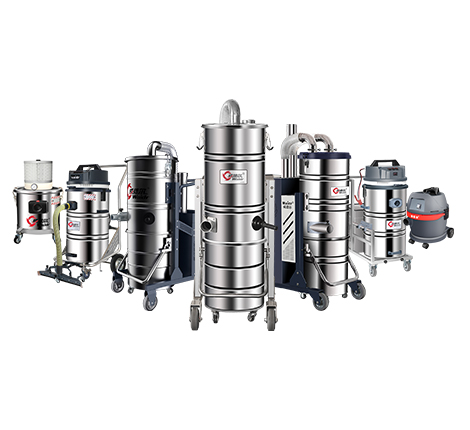
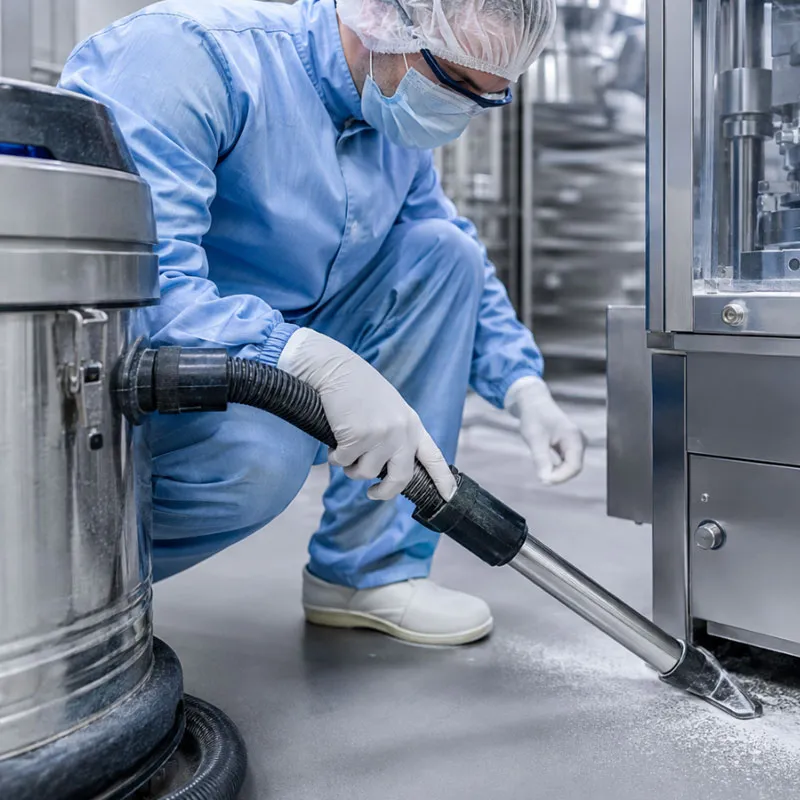
Pharmaceutical production demands a different standard of industrial cleaning. The objective is not only to remove visible residue but also to manage fine powder, support housekeeping discipline, redu...
Read More
Choose a 3 phase vacuum cleaner when the application requires long operating hours, higher sustained power, production-line integration, large dust loads, or demanding pressure and airflow. Choose a single phase industrial vacuum when standard power availability, mobility, lighter duty, and lower installation complexity are more important. The correct decision depends on the complete operating point, not voltage or kilowatts alone. Compare material, duty cycle, hose restriction, filter loading, container capacity, electrical infrastructure, and total cost.
Industrial buyers often begin with a simple question: “Do we need single phase or three phase?” The useful answer comes only after the cleaning task is defined. A portable single phase machine can outperform a poorly selected three phase model in a short, high-airflow task. A three phase turbine can provide far better reliability than multiple universal motors when the vacuum runs continuously beside a production line. The electrical phase is important, but it is one part of a larger system.
Waidr Vacuum Cleaner (Shanghai) Co., Ltd. manufactures single phase, three phase, battery-powered, pneumatic, engine-powered, explosion-proof, oil-and-chip, food and pharmaceutical, textile, high-temperature, and central vacuum equipment. This guide uses published Waidr model specifications to show how procurement teams can compare options without assuming that the largest motor or highest airflow is always the best choice.
A 3 phase vacuum cleaner is an industrial vacuum powered by a three-phase electrical supply and commonly built around a side-channel blower, turbine, or other motor system intended for sustained industrial operation.
Three-phase power delivers alternating current through three conductors whose waveforms are offset from one another. In industrial motor applications, that arrangement supports smooth torque production and is widely used for machinery that runs for long periods. The vacuum still needs suitable motor protection, controls, filters, relief devices, and a collection system designed for the actual debris.
Waidr’s compact three-phase models WX80/22, WX80/30, and WX80/40 are listed at 380 V with power ratings of 2.2, 3.0, and 4.0 kW. Published airflow values are 275, 318, and 420 cubic meters per hour, while vacuum pressure is 248, 270, and 270 mbar. The series uses an 80 L container and a 28,800 square centimeter filter area. These numbers demonstrate that models within the same electrical category can have different operating characteristics.
Buyers evaluating a 3 phase vacuum cleaner should compare the actual model curve, filter condition, hose, tool, and duty cycle rather than relying only on the rated kilowatts.
A single phase industrial vacuum is a cleaning or material-recovery machine designed to operate from a single-phase electrical supply, typically chosen for easier connection, mobility, and intermittent or moderate industrial duty.
Single phase does not automatically mean low performance or commercial-only construction. Waidr publishes several types. The WX-2210FB uses a 220 V, 2.2 kW brushless side-channel blower with 270 cubic meters per hour airflow, 230 mbar vacuum, a 32,000 square centimeter filter area, and a 100 L container. The WX-3610 wet and dry model is listed at 220 V and 3.6 kW with 572 cubic meters per hour airflow, 205 mbar vacuum, a 26,800 square centimeter filter area, and a 100 L container.
These examples show why phase alone is not a performance ranking. The 3.6 kW single phase wet and dry model has higher published free-air volume than some compact three-phase models, while the three-phase units are designed around continuous turbine duty and different pressure characteristics. The right machine depends on the debris, pickup tool, operating hours, and required durability.
The core difference is that a three-phase vacuum generally prioritizes sustained motor duty and industrial integration, while a single-phase vacuum generally prioritizes convenient power access and flexible deployment.
| Comparison Factor | 3 Phase Vacuum Cleaner | Single Phase Industrial Vacuum | Selection Question |
|---|---|---|---|
| Electrical supply | Requires compatible three-phase voltage, frequency, protection, and connection | Connects to suitable single-phase industrial supply | What power is available at every intended work area? |
| Typical duty | Continuous or long-duration industrial operation | Intermittent, shift cleaning, mobile, or moderate-duty use; some brushless models support longer duty | How many minutes or hours will the motor run without stopping? |
| Power range | Commonly scales into higher motor powers and larger systems | Commonly used at lower and medium powers, depending on local supply limits | What airflow and vacuum are required at the operating point? |
| Mobility | May be mobile but often installed near machinery or used within a defined factory area | Usually easier to move between outlets and departments | Will the vacuum stay at one machine or travel through the plant? |
| Installation | May require electrician, industrial plug, isolator, phase protection, and fixed connection | Usually simpler where suitable outlets already exist | Is the electrical installation included in project cost? |
| Maintenance pattern | Turbine or side-channel blower systems often emphasize sustained service and planned maintenance | Depends on motor type; multi-motor bypass systems may use replaceable motor modules | What service skill and spare parts are available locally? |
| Best-fit applications | Production lines, heavy debris, large dust loads, long hose, high pressure, central or stationary duty | General factory cleaning, wet and dry pickup, maintenance teams, changing work areas | Is the task process-critical or primarily scheduled housekeeping? |
The table describes common tendencies, not absolute rules. A brushless single phase side-channel blower may support extended industrial use. A small three-phase vacuum may be compact and mobile. Procurement specifications should describe required performance and duty before naming the phase.
Duty cycle is the pattern of operating time, rest time, load, and environmental conditions the vacuum experiences during a shift.
A vacuum used for ten minutes at the end of each shift faces a different thermal and mechanical load from a machine that extracts dust continuously from a production line. Frequent start-stop cycles also affect motors, contactors, and controls. A motor that appears powerful in a short test may not be appropriate for sustained operation if cooling, bearings, or protection are designed for intermittent duty.
Ask the operations team to document:
Maximum continuous run time.
Total operating hours per shift and per day.
Number of starts per hour.
Normal and peak material loading.
Ambient temperature and ventilation.
Whether the inlet can be blocked during tool changes.
Whether production must stop if the vacuum is unavailable.
Waidr states that selected compact three-phase turbine models can operate continuously. That capability is valuable for machine integration, but the full system must still be maintained. A blocked filter, closed inlet, full container, incorrect phase sequence, high ambient temperature, or failed relief device can create abnormal conditions. Continuous-duty equipment does not mean maintenance-free equipment.
Airflow is the volume of air moving through the system, while vacuum pressure is the pressure difference available to overcome resistance and lift or convey material.
Light dust, fibers, and broad floor tools may benefit from adequate airflow. Dense material, narrow nozzles, long hoses, vertical lift, and restrictive process connections may require more vacuum pressure. Both values change when the filter loads or the hose bends. Maximum airflow and maximum vacuum usually occur at different points on a performance curve, so comparing catalog maxima can be misleading.
Consider the published Waidr examples:
WX80/22 three phase: 2.2 kW, 275 m3/h, 248 mbar.
WX80/40 three phase: 4.0 kW, 420 m3/h, 270 mbar.
WX-2210FB single phase brushless: 2.2 kW, 270 m3/h, 230 mbar.
WX-3610 single phase wet and dry: 3.6 kW, 572 m3/h, 205 mbar.
The 3.6 kW wet and dry machine shows higher published airflow but lower vacuum than the compact three-phase models. It may be excellent for broad cleaning and wet pickup, while a three-phase model may maintain stronger performance through a restrictive hose or process connection. The final choice should be tested at the required hose length and tool.
A three-phase vacuum is usually the better choice when sustained duty, higher pressure, production integration, large dust loads, or future capacity are more important than plug-and-move convenience.
When the vacuum connects to a grinder, packaging machine, filling line, CNC cell, conveyor, or process enclosure, availability becomes part of production uptime. The unit may run whenever the machine runs and may need remote start, interlock, level sensing, automatic filter cleaning, or automatic discharge. Three-phase turbine systems are commonly selected for this type of duty.
Facilities that clean continuously or for several hours at a time should prioritize motor construction, cooling, bearings, overload protection, phase monitoring, and relief design. Waidr’s compact three-phase page lists Delixi protection functions for overheating, overload, and phase protection, plus a pressure relief valve that introduces compensation air when the filter or inlet is blocked.
Metal chips, foundry sand, dense powders, pellets, and continuous process waste may require more sustained vacuum and larger separation capacity. A pre-separator can protect the main filter and reduce emptying frequency. The vacuum producer should be selected from pressure losses and material-conveying demand, not material weight alone.
A heavy duty industrial vacuum can be appropriate for factories, workshops, and construction environments where durability, filter area, and long operating time are more important than low machine weight. Waidr’s heavy-duty WKM series is listed at 380 V with power options from 2.2 to 7.5 kW, a 100 L container, and HEPA cartridge filtration. Actual model specifications should be confirmed in the current quotation and technical sheet.
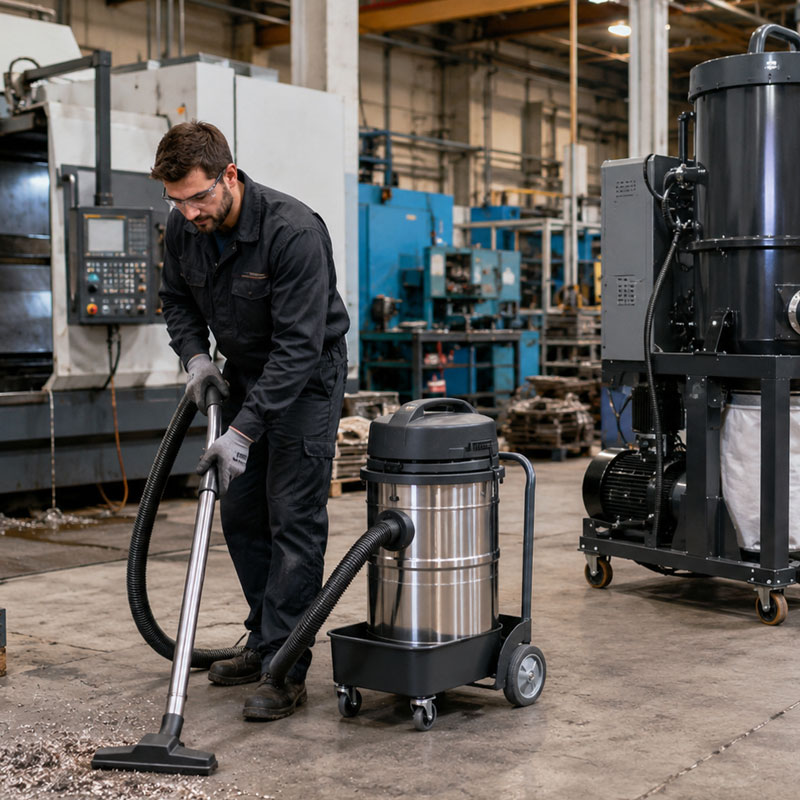
A single phase industrial vacuum is usually the better choice when the cleaning team moves frequently, suitable three-phase outlets are unavailable, operating periods are shorter, or installation simplicity has high value.
Maintenance technicians may clean several departments, machines, or storage areas during one shift. A single-phase machine can connect to existing approved outlets and avoid a specialized extension or fixed installation. Cable length, plug type, voltage, frequency, and circuit capacity must still be checked.
Single phase multi-motor units are common for wet and dry pickup because they can provide high airflow and allow staged motor switching. Waidr’s WX-3610 uses a 100 L container and three motors with independent control according to the product description. The application should still confirm liquid compatibility, drainage, foam, filters, and whether chips or oil require separation.
If the machine operates for short periods and is stored between tasks, the capital and installation cost of a three-phase unit may not produce a return. The decision should account for actual hours, labor saved, cleaning result, and downtime rather than a general belief that industrial facilities always need three phase.
Temporary production lines, rental spaces, warehouses, and construction projects may value flexible deployment. A single phase or battery-powered machine can adapt more easily when equipment moves. The buyer should not create long, undersized extension-cable arrangements; the electrical connection must remain suitable for the load and environment.
Model comparison should use voltage, power, airflow, vacuum, filter area, container capacity, inlet, noise, weight, and dimensions together because each parameter affects a different part of the cleaning task.
| Model Example | Supply | Power | Airflow | Vacuum | Filter Area | Container | Use Interpretation |
|---|---|---|---|---|---|---|---|
| Waidr WX80/22 | 380 V three phase | 2.2 kW | 275 m3/h | 248 mbar | 28,800 cm2 | 80 L | Compact continuous-duty option for industrial dust, chips, and production support |
| Waidr WX80/40 | 380 V three phase | 4.0 kW | 420 m3/h | 270 mbar | 28,800 cm2 | 80 L | Higher airflow within the compact series for heavier or faster collection demand |
| Waidr WKM-7510SD | 380 V three phase | 7.5 kW | Published value depends on current technical sheet | Published value depends on current technical sheet | Heavy-duty cartridge configuration | 100 L | Higher-power plant duty requiring model-level verification |
| Waidr WX-2210FB | 220 V single phase | 2.2 kW | 270 m3/h | 230 mbar | 32,000 cm2 | 100 L | Brushless single-phase alternative for longer industrial use where three phase is unavailable |
| Waidr WX-3610 | 220 V single phase | 3.6 kW | 572 m3/h | 205 mbar | 26,800 cm2 | 100 L | High-airflow wet and dry cleaning with convenient single-phase supply |
Published web pages and PDF sheets may be updated at different times, so a purchase order should reference the approved technical sheet attached to the quotation. Where two published sources show different airflow, vacuum, or filter-area values, ask Waidr to confirm the current configuration and revision.
Filtration performance is the ability of the complete vacuum to retain the target particles while maintaining usable airflow as dust accumulates.
A powerful motor cannot compensate indefinitely for a small, unsuitable, or clogged filter. Fine powder can coat the media and increase resistance quickly. Fibers can bridge across the surface. Oil mist can make dry dust sticky. Abrasive particles can damage filters and hoses. The selection should therefore include filter area, media, cleaning method, pre-separation, seal integrity, and disposal.
NIOSH defines HEPA filtration as at least 99.97 percent efficient at capturing 0.3 micrometer particles under the stated definition. In a vacuum, the total result also depends on the housing and bypass seals. A HEPA label does not automatically make a machine suitable for toxic dust, cleanrooms, food contact, pharmaceuticals, or combustible dust. Those applications require additional material, hygiene, containment, and safety decisions.
Ask how the filter is cleaned. Manual shaking may suit intermittent duty. Reverse-air or pulse cleaning may support heavier loads. Automatic cleaning reduces operator dependence, but it requires appropriate controls and compressed air where applicable. The clean and loaded filter pressure loss should be included in performance calculations.
Electrical infrastructure includes the supply voltage, frequency, circuit capacity, protection, cable, connector, isolation, grounding, phase sequence, and environmental suitability required to operate the vacuum safely.
Three-phase installation may require an industrial receptacle or fixed isolator, correctly sized protective device, motor starter, overload protection, and phase monitoring. A plant electrician should verify the connection. Different countries use different voltages, frequencies, plugs, and wiring practices. A machine listed at 380 V should not be assumed compatible with every three-phase system without confirmation.
Single-phase machines also require proper circuits. High-power vacuums can exceed ordinary outlet capacity or cause voltage drop through long extension cords. The supplier should confirm rated current, starting characteristics, plug, cable, and local requirements. OSHA electrical rules emphasize that equipment must be suitable for its identified installation and use.
Hazardous locations create a separate decision. A standard three-phase or single-phase vacuum is not suitable merely because it has an industrial motor. Combustible dust, gas, vapor, or mist requires a location-specific review and potentially certified equipment, conductive accessories, bonding, grounding, and ignition controls.
Mobility and ergonomics determine whether operators can move, position, use, and empty the vacuum safely throughout the real work area.
Machine weight, wheel diameter, handle position, floor condition, ramps, elevators, thresholds, hose storage, cable management, and container removal can matter more than a small performance difference. A 100 L container filled with dense metal or sand may be too heavy for manual emptying. A smaller removable bin or pre-separator may improve safety and productivity.
Three-phase vacuums may stay near a production cell, reducing movement. Single-phase units may travel more, increasing exposure to cable damage and hose wear. Plan where operators will store accessories, clean filters, empty waste, and connect power. If the cleaning route crosses hazardous or wet areas, the machine and connection must be suitable.
Maintenance planning identifies the filters, seals, hoses, motors, controls, wheels, containers, and protection devices that must be inspected or replaced to preserve performance.
Three-phase turbine systems often have fewer consumable motor brushes than universal-motor arrangements, but bearings, filters, seals, valves, contactors, and protection devices still require service. Multi-motor single-phase units may allow one motor to be switched independently or replaced as a module, which can simplify certain repairs. Brushless single-phase side-channel blower designs provide another maintenance profile.
Compare suppliers on:
Recommended inspection intervals.
Filter life under a defined dust load.
Motor or turbine service procedure.
Availability of hoses, filters, seals, switches, and wheels.
Diagnostic indicators and protection alarms.
Local service capability and remote technical support.
Time required to empty waste and clean filters.
Whether maintenance can occur without stopping production.
For a process-critical vacuum, consider a standby machine, parallel unit, spare filter, or bypass plan. The cost of downtime may exceed the price difference between single and three phase.
Lifecycle cost is the total cost of purchase, electrical installation, energy, filters, bags, maintenance, labor, waste handling, downtime, and replacement over the planned service period.
A three-phase vacuum may require a higher initial installation cost but deliver better value when it runs continuously and avoids motor replacement or production stops. A single-phase vacuum may be more economical when it operates only a few hours per week and moves between existing outlets. The correct comparison uses annual operating hours and measured productivity.
A practical cost model includes:
Equipment and accessories.
Electrical work and controls.
Annual energy based on measured or estimated operating load.
Filters, liners, and wear parts.
Scheduled maintenance labor.
Expected repair and motor service.
Operator cleaning time.
Production downtime related to cleaning or vacuum failure.
Waste-disposal handling.
Residual value and expected service life.
The U.S. Department of Energy recommends treating motors as part of a complete system rather than focusing only on individual component efficiency. For a vacuum, pipe restriction, leaks, blocked filters, oversized motors, and poor controls can waste more energy than a small difference in motor efficiency.
A decision matrix converts application priorities into a transparent selection rather than relying on a sales label.
| Application Condition | Preferred Direction | Reason | Additional Check |
|---|---|---|---|
| Runs beside a production line for most of the shift | Three phase | Sustained industrial motor duty and integration options | Confirm loaded-filter operating point and automatic discharge need |
| Moves through several departments for scheduled cleanup | Single phase | Easier access to suitable power and flexible deployment | Check circuit capacity, cable route, and duty duration |
| Collects dense chips through long hose and vertical lift | Often three phase or high-vacuum system | Greater pressure demand and sustained load | Calculate hose loss and consider pre-separation |
| Collects large volumes of light dry debris for short periods | Application dependent; high-airflow single phase may fit | Airflow and container may matter more than phase | Test tool performance and filter loading |
| Wet and dry maintenance cleaning | Often single phase mobile unit | Convenient movement and available wet/dry architectures | Confirm liquid compatibility and disposal |
| High dust load with continuous filter resistance | Three phase with suitable filter cleaning | Long duty and automatic cleaning options | Size filter area and compressed-air demand |
| Hazardous classified location | Neither standard option by default | Requires certified hazardous-duty configuration | Verify zone, material, marking, and complete conductive path |
| No convenient electrical supply | Battery, pneumatic, gasoline, or diesel alternative | Mobility and utility availability drive selection | Review runtime, air consumption, emissions, and location limits |
Application data is the technical information Waidr needs to select a model and confirm that published performance matches the real cleaning task.
Send:
Material name, particle size, bulk density, moisture, and temperature.
Combustibility, toxicity, abrasiveness, and chemical compatibility.
Collection rate per minute, hour, or shift.
Maximum continuous run time and daily hours.
Hose diameter, length, vertical lift, and pickup tool.
Wet, dry, oil, chips, fibers, or mixed debris.
Required container size and disposal method.
Available voltage, frequency, plug, and circuit conditions.
Indoor, outdoor, cleanroom, washdown, or hazardous environment.
Production-line controls, remote start, level sensing, or automatic discharge.
Waidr states more than 20 years of industrial vacuum experience, a 20,000 square meter production base, and service to more than 30,000 clients. Those company facts help establish manufacturing scale, while the final purchasing decision should rely on the approved model specification, drawings, certificate requirements, and acceptance test.
Buyers who have not yet defined the product category can begin with Waidr’s industrial vacuum cleaner range and then compare single phase, three phase, battery, pneumatic, engine-powered, oil-and-chip, food and pharmaceutical, textile, and special-industry options.
No. Some single-phase models have higher published airflow or similar motor power than compact three-phase models. Three phase generally offers a practical path to sustained industrial motor duty and higher power ranges, but performance depends on airflow, vacuum pressure, filter resistance, hose, tool, and operating point. Compare exact models under the same task rather than comparing phase labels.
Some brushless side-channel blower single-phase models may be designed for extended or continuous industrial duty, while many multi-motor bypass machines are better suited to intermittent operation. The buyer should request the manufacturer’s stated duty, ambient limits, cooling requirements, and protection features. “Single phase” alone does not define duty cycle, and “industrial” should not be interpreted as automatic 24-hour capability.
Several Waidr three-phase product pages list 380 V, while some machine-matched models state that 220 V may be optional. Voltage and frequency requirements vary by destination and model. The quotation should confirm the exact supply, phase, frequency, plug or isolator, rated current, motor protection, and phase sequence. Do not order from the voltage shown on a different model page.
The best machine depends on chip size, liquid volume, oil type, collection rate, hose length, and whether the task is continuous. A wet and dry single-phase machine may be suitable for mobile maintenance, while a three-phase oil-and-chip system may be better for continuous production recovery. Solid-liquid separation, drain method, filter protection, and safe container handling are usually more important than phase alone.
No. Kilowatts describe motor input or rated power, not the complete pickup result. Fan or turbine design, airflow, vacuum pressure, speed, filter resistance, hose diameter, leakage, and tool restriction determine suction at the work surface. A high-kW machine operating through a clogged filter can perform worse than a smaller correctly maintained system. Request the operating curve or test at the required configuration.
Compare installation cost, annual operating hours, energy, filters, maintenance, motor repairs, operator labor, cleanup time, production downtime, and service life. The change is more likely to deliver value when the vacuum runs many hours, supports production, or repeatedly overloads existing units. For occasional housekeeping, a properly selected single-phase machine may remain the lower-cost solution.
1. U.S. Department of Energy, Motor Systems Resources: https://www.energy.gov/cmei/ito/motor-systems
2. U.S. OSHA Standard 1910.303, General Electrical Requirements: https://www.osha.gov/laws-regs/regulations/standardnumber/1910/1910.303
3. National Electrical Manufacturers Association, Fundamentals of Electric Motors: https://www.nema.org/docs/default-source/motor-and-generator-guides-and-resources-library/1-fundamentals-of-electric-motors-v2.pdf
A 3 phase vacuum cleaner is not automatically the right answer for every factory, and a single phase industrial vacuum is not automatically light duty. Three phase generally provides the strongest platform for continuous operation, higher power, production integration, long hoses, and heavy material loads. Single phase generally provides easier electrical access, mobility, wet and dry flexibility, and lower installation complexity.
The best decision comes from the material, operating hours, airflow and pressure requirement, filter loading, container, hose, power infrastructure, maintenance strategy, and downtime cost. Send Waidr a complete application description and request a model-level comparison using the same pickup task. That approach turns an electrical-phase question into a reliable industrial cleaning specification.