English
 français
 Español
 русский
 português
 العربية
 tiếng việt
 Türkçe
 ไทย
ไทย Indonesia
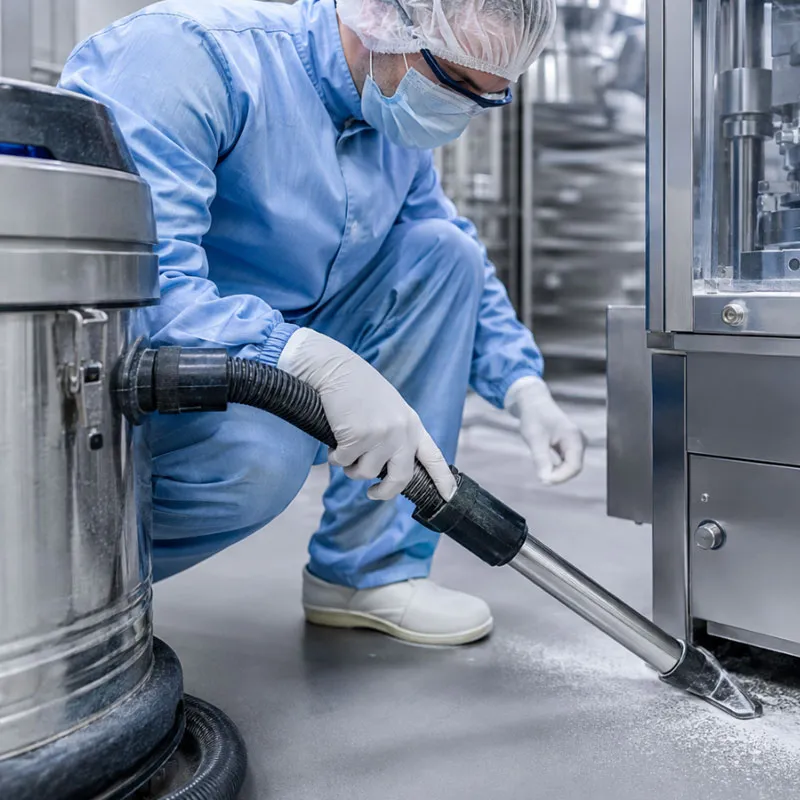
Pharmaceutical production demands a different standard of industrial cleaning. The objective is not only to remove visible residue but also to manage fine powder, support housekeeping discipline, redu...
Read More
An explosion proof vacuum cleaner should be selected from the actual material hazard, area classification, ignition risks, collection method, filtration requirement, and operating duty—not from suction power alone. Buyers should confirm whether the equipment certification and marking match the intended gas or dust zone, verify that the complete recovery path is conductive and bonded, and provide the supplier with dust data, process conditions, voltage, pickup distance, and disposal method before a model is specified.
Combustible dust control is a plant-safety decision as well as a cleaning decision. Fine particles from metals, grain, sugar, pharmaceuticals, chemicals, plastics, wood, coal, paper, and some textile processes can form an ignitable atmosphere under certain conditions. A standard industrial vacuum may contain motors, switches, bearings, static-producing hoses, or other components that are unsuitable for a classified location. The wrong machine can therefore add an ignition source to the exact area it is expected to clean.
Waidr Vacuum Cleaner (Shanghai) Co., Ltd. designs industrial vacuum equipment for demanding production environments, including electric, pneumatic, immersion-bath, mobile, and centralized configurations. This guide explains the questions a procurement team, safety manager, maintenance engineer, and equipment supplier should resolve before choosing a system. It is not a substitute for a site-specific dust hazard analysis, hazardous-area classification, or review by the responsible safety professional.
An explosion proof vacuum cleaner is an industrial recovery system engineered and certified, where applicable, to reduce the risk that its electrical, mechanical, or electrostatic components will ignite a flammable gas, vapor, mist, or combustible-dust atmosphere within its stated equipment category and operating limits.The phrase does not mean that the vacuum is indestructible or that it can safely collect every hazardous material. It means that the equipment has a defined protection concept and is intended for specific conditions shown by its certificate, marking, instructions, and configuration. The buyer must match those conditions to the workplace. A machine intended for one dust zone, gas group, temperature class, or material type should not be assumed suitable for another.
For a procurement team, the most important distinction is between a product description and a verifiable configuration. A generic web page may introduce an ATEX vacuum cleaner family, but the purchase decision should be based on the exact model, motor or air-drive arrangement, filter, hose, accessories, collection container, earthing method, and certificate supplied with the quotation. Changes to accessories can affect the safety of the full recovery path.
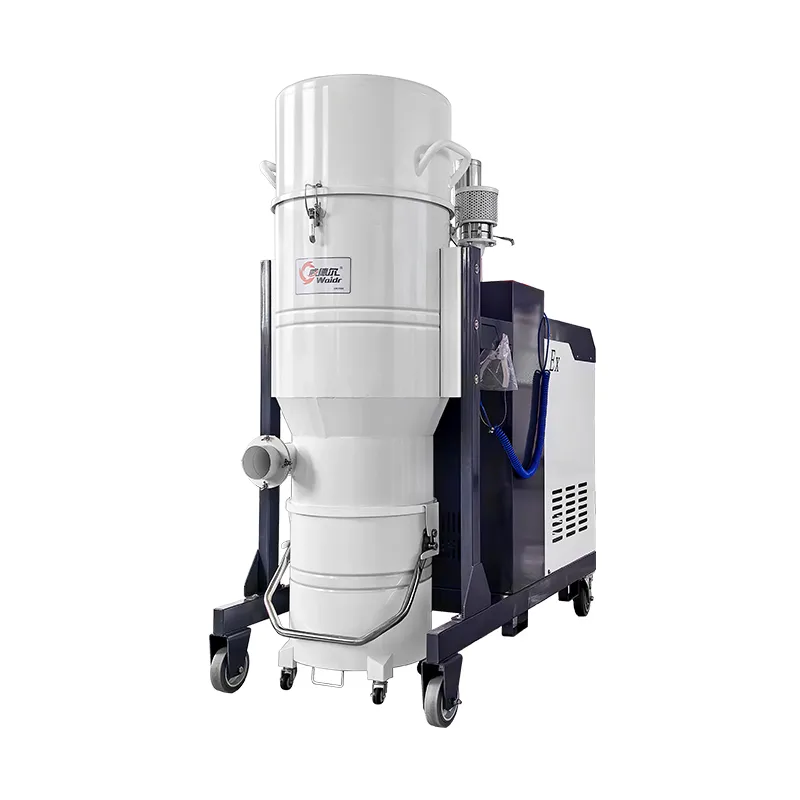
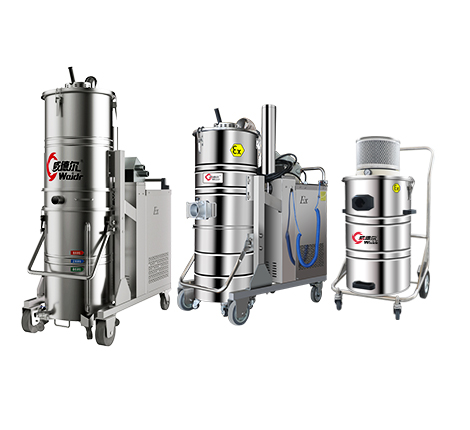
Waidr organizes hazardous-area products within its explosion proof vacuum cleaner range. Buyers should use that category as the starting point, then request a model-level verification against the intended material and location.
Combustible dust is finely divided solid material that can present a fire or deflagration hazard when dispersed in air under the right concentration and exposed to a sufficient ignition source.
A settled layer may appear harmless, but routine movement, leakage, compressed-air cleaning, sweeping, vibration, or a primary event can suspend particles. A dust incident often becomes severe when an initial event disturbs accumulated material on beams, ducts, cable trays, machinery, and other elevated surfaces, creating a larger secondary cloud. Good housekeeping therefore matters, but the cleaning method must not introduce another hazard.
OSHA guidance identifies many materials that may be combustible in dust form, including aluminum, magnesium, wood, coal, plastics, sugar, paper, pharmaceuticals, and certain textile materials. Whether a specific material is hazardous depends on its composition, particle size, moisture, contamination, process temperature, and test data. A safety data sheet can provide useful information, but it may not contain every explosibility parameter needed for an engineered decision.
Before discussing motor power or container volume, ask:
What material will be collected, and is it a single material or a mixture?
Is the dust combustible, conductive, reactive, toxic, corrosive, or moisture-sensitive?
Could the collected material contain hot particles, sparks, liquids, solvents, or incompatible residues?
Is the pickup point inside a classified area, outside it, or connected to one through ducting?
Will the vacuum collect routine housekeeping dust, process dust directly at source, or accidental spills?
How will the waste be removed, sealed, transported, and disposed of?
These questions determine whether the project needs an electric certified unit, a pneumatic system, a wet or immersion-bath collection method, a stationary central system, a pre-separator, or a different engineering control altogether.
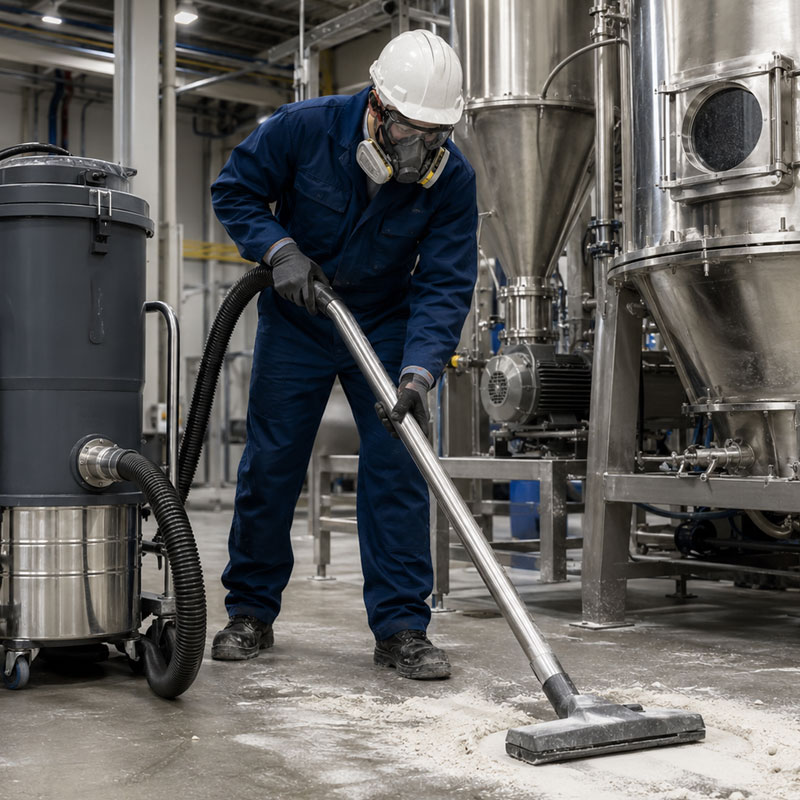
Hazardous-area matching is the process of confirming that the complete vacuum configuration is permitted for the classified location and material conditions identified by the facility’s risk assessment.
In the European framework, ATEX commonly refers to two directives: one addresses equipment and protective systems placed on the market, while the other addresses worker protection in potentially explosive atmospheres. The equipment directive 2014/34/EU defines essential health and safety requirements and conformity-assessment procedures. A buyer should not stop at the word “ATEX”; the exact marking and supporting documentation must be checked.
Area classification reflects how frequently and for how long an explosive atmosphere is expected to occur. Dust and gas classifications are not interchangeable. The facility is responsible for classifying the area, normally with competent safety and engineering input. The vacuum supplier then uses that classification, together with the material data and application description, to identify a compatible equipment category and protection concept.
A useful purchasing checklist includes:
Site country and applicable regulatory framework.
Gas, vapor, mist, dust, or hybrid atmosphere.
Hazardous-area zone or North American class/division or zone information.
Material group and relevant ignition characteristics.
Required temperature class or maximum surface-temperature limit.
Ambient temperature and process-material temperature.
Indoor, outdoor, washdown, corrosive, or cleanroom environment.
Required certificate, declaration, nameplate marking, and documentation language.
Do not ask a supplier to “make it ATEX” without this information. The phrase is too broad to define a safe configuration. Likewise, do not assume that a machine certified for use outside a hazardous zone can place its hose and accessories inside the zone without a specific review. The boundary between classified and unclassified space, the position of the vacuum, the route of the hose, and the discharge location all matter.
The three main hazardous-duty vacuum approaches differ in how suction is generated and how collected material is controlled, so the best choice depends on the available utilities and the ignition or reaction characteristics of the material.
| Configuration | How Suction Is Produced | Typical Strengths | Important Limitations | Best-Fit Questions |
|---|---|---|---|---|
| Electric explosion-proof vacuum | Certified electric motor or turbine arrangement | Independent operation, predictable performance, suitable for many routine industrial cleaning duties | Electrical classification, cable, plugs, controls, motor location, and temperature limits must match the area | Is compatible electrical power available, and does the exact certification match the zone? |
| Pneumatic explosion-proof vacuum | Compressed air drives a venturi or air-powered suction system | No electric motor at the pickup machine; useful where compressed air is reliable and electrical ignition sources are undesirable | Requires sufficient air volume and pressure; compressed-air energy cost and plant capacity must be checked | Can the air system maintain demand without reducing production equipment performance? |
| Immersion-bath or wet collection vacuum | Electric or pneumatic suction combined with a liquid bath intended to control certain reactive or combustible particles | Can reduce airborne release and address specific metal-dust or reactive-material collection strategies | Liquid compatibility, hydrogen or gas generation, sludge handling, corrosion, inspection, and disposal require specialist review | Has the material been tested for compatibility with the chosen liquid and disposal method? |
| Stationary or central hazardous-duty system | Remote vacuum producer connected to fixed piping and pickup points | Supports multiple work areas, reduces movement of portable units, allows equipment to be located outside some process areas | Pipeline design, simultaneous use, pressure loss, isolation, explosion protection, and safe discharge become project-level issues | How many pickup points operate at once, and where can the main unit and collector be safely located? |
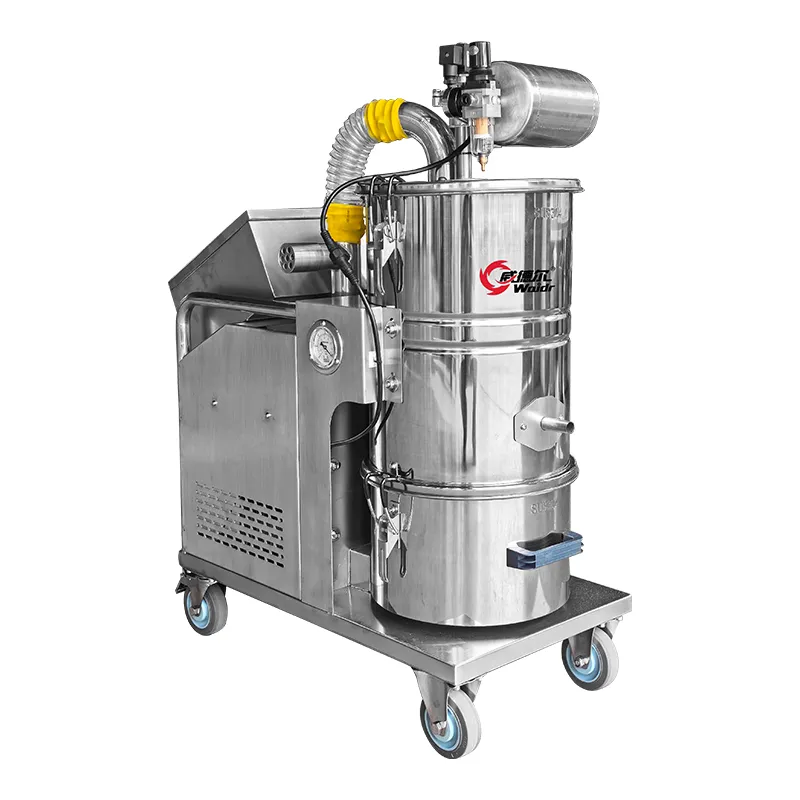
Waidr also offers pneumatic models with capacities stated from 15 L to 80 L for specific product families. Capacity alone should not drive the decision. A smaller container may be preferable when the material is dense, hazardous, or subject to strict disposal limits, while a larger container may reduce interruptions for low-density dust. The safe manual handling weight should be calculated from bulk density, not volume alone.
Critical features are the design elements that maintain a controlled, conductive, mechanically suitable, and appropriately filtered path from the pickup tool to the collection and discharge point.
OSHA guidance for combustible particulate collection emphasizes appropriate construction materials, conductive or static-dissipative hoses, and bonding and grounding of conductive components. The nozzle, wand, couplings, hose, inlet, separator, filter housing, container, frame, and grounding connection should be evaluated as a complete path. One conductive component does not compensate for an insulating break elsewhere.
The hose should be compatible with abrasion, chemicals, temperature, bending radius, and required conductivity. Long hoses increase pressure loss and may be more difficult to inspect. Accessories should not be substituted casually after commissioning; a non-conductive replacement nozzle or hose can change the risk profile.
The motor, blower, bearings, fan, controls, and electrical enclosure must follow the protection concept stated for the equipment. Mechanical impact and friction also matter. The system should reduce the chance that collected metal pieces, fasteners, or hot debris strike incompatible components and create sparks. If hot particles are possible, a pre-separation or cooling strategy may be necessary, and the supplier should receive the maximum credible material temperature rather than the normal average.
A filter must retain the target particles while maintaining airflow throughout the cleaning cycle. “HEPA” describes a filtration performance category, not an explosion-protection certificate. NIOSH defines a HEPA filter as at least 99.97% efficient at capturing 0.3 micrometer particles under the stated test context. Actual machine containment also depends on seals, installation, housing integrity, filter loading, cleaning method, and whether dust can bypass the media.
Fine powder often loads a filter rapidly. A large filter area, pre-separation, automatic or manual cleaning, and a suitable air-to-cloth loading strategy can preserve performance. Conductive or antistatic filter media may be required for some combustible-dust applications. Toxic or potent materials may also require safe-change containment, closed-bag disposal, or additional downstream filtration.
The collection method should prevent uncontrolled dust release when the operator empties the machine. A large container may improve productivity but create a heavier, more difficult disposal task. Consider liner compatibility, conductive bags, endless-bag systems, sealed drums, lifting aids, forklift access, and the destination of the waste.
For wet or immersion collection, the disposal plan must address liquid level, sediment, reaction potential, corrosion, evaporation, gas release, cleaning, and treatment of the resulting slurry. Never introduce water or another liquid to reactive dust without a documented compatibility decision.
Performance selection is the process of balancing airflow, vacuum pressure, hose diameter, pickup distance, debris characteristics, filter resistance, and duty cycle so that the machine collects material effectively without being unnecessarily oversized.
Airflow helps carry suspended particles and light material through the hose. Vacuum pressure helps overcome resistance and lift dense debris or pull through restrictive tools and long hoses. A high number in one category does not guarantee strong real-world pickup if the other factors are poorly matched. The operating point changes as the filter loads, the hose bends, the pickup tool narrows, and the container fills.
Ask the supplier to evaluate:
Bulk density and largest particle or chip size.
Required pickup distance and vertical lift.
Hose diameter, number of bends, and accessory restriction.
Expected collection rate per minute or per shift.
Dry, wet, sticky, fibrous, abrasive, or cohesive material behavior.
Continuous, intermittent, or production-line-integrated duty.
Filter area, cleaning method, and acceptable pressure-loss range.
Noise, exhaust location, and heat released into the workspace.
For large facilities or multiple simultaneous pickup points, a portable vacuum may not be the correct architecture. An industrial central vacuum system can move the vacuum producer and collector to a controlled location while fixed piping serves several work areas. That alternative requires engineering calculations and should be compared on total lifecycle cost rather than machine price alone.
A standard industrial vacuum is designed for general debris and process cleaning, while an explosion-proof model adds a defined protection strategy for a specific hazardous atmosphere and must be matched to the classified location.
| Selection Factor | Standard Industrial Vacuum | Explosion Proof Vacuum | Buyer Action |
|---|---|---|---|
| Intended area | Unclassified industrial areas | Specific classified area stated by equipment marking and documentation | Obtain the facility’s area classification before quotation |
| Material | Non-combustible general dust, debris, chips, or liquids within machine limits | Defined combustible dust, gas, vapor, or hazardous material conditions | Provide material test data and contamination information |
| Static control | May use ordinary hoses and accessories | Conductive or static-dissipative path with bonding and grounding as required | Verify every accessory in the supplied configuration |
| Motor and controls | General industrial construction | Protection concept appropriate to the certified use | Check nameplate, certificate, controls, cable, and plugs |
| Documentation | Manual and technical data | Manual, declaration, certificate details, marking, restrictions, and maintenance requirements | Include documents in purchase acceptance criteria |
| Change control | Accessories may be changed within general compatibility limits | Changes can affect conductivity, certification, temperature, or protection concept | Require approval for replacement parts and modifications |
| Price basis | Capacity and cleaning performance | Performance plus certification, protection, conductive components, and documentation | Compare total risk and lifecycle cost, not purchase price only |
For general non-classified production areas, buyers can review Waidr’s broader industrial vacuum cleaner range. The decision to move from a general industrial unit to a certified hazardous-duty system should be based on the facility risk assessment rather than a preference for a more expensive machine.
A reliable procurement process converts site hazards and production needs into verifiable technical requirements before the purchase order is placed.
Collect material data. Identify the product, contaminants, particle size, bulk density, moisture, temperature, abrasiveness, toxicity, conductivity, and known combustibility parameters.
Confirm area classification. Record the exact pickup location, machine location, hose route, waste-disposal location, and any boundary between classified and unclassified space.
Define the cleaning task. Distinguish routine housekeeping from process extraction, spill recovery, machine integration, overhead cleaning, or emergency response.
Calculate operating demand. State pickup rate, hose length, vertical lift, number of simultaneous users, duty hours, and acceptable interruption for emptying or filter cleaning.
Select the protection approach. Compare certified electric, pneumatic, immersion-bath, pre-separated, portable, and central configurations.
Review documentation. Check certificate applicability, equipment marking, manuals, declaration, drawings, grounding instructions, spare-parts list, and maintenance intervals.
Commission and control changes. Inspect continuity and grounding, train operators, record the approved configuration, and prevent unauthorized accessories or modifications.
A supplier questionnaire should be attached to the request for quotation. This reduces the risk that sales teams quote only from a keyword such as “ATEX vacuum” without understanding the application. It also makes quotations easier to compare because each supplier responds to the same conditions.
Installation and maintenance preserve the protection features documented for the approved vacuum configuration throughout its service life.
Before first use, inspect the nameplate, certificate references, power connection, grounding point, hose continuity, accessories, filter installation, seals, container closure, and exhaust route. Confirm that the operator understands prohibited materials and temperature limits. Where the equipment uses compressed air, verify pressure, flow, hose rating, and air quality.
A practical inspection program may include checks before every shift, scheduled filter and seal inspections, continuity testing at a facility-defined interval, and documented review after any repair or accessory change. The interval should follow the manufacturer’s instructions, operating severity, dust abrasiveness, chemical exposure, and site safety program. A visual check alone may not confirm electrical continuity or internal filter damage.
Filters should be cleaned by the designed mechanism. Aggressive compressed-air cleaning can damage media or disperse hazardous dust. Collected material should be removed in a controlled area using the approved liner, container, or disposal procedure. Maintenance technicians should treat residue inside hoses, filters, separators, and collection chambers as process material, not ordinary dirt.
Specification mistakes occur when a buyer selects a hazardous-duty vacuum from a product label, a single performance number, or a previous application without checking the new site conditions.
Using “explosion proof” as a universal requirement. The correct protection depends on the classified area, material, and applicable framework.
Ignoring the waste mixture. Metal dust mixed with oil, solvent, moisture, or other dust may behave differently from the pure material.
Focusing only on motor power. Hose loss, filter loading, pickup tool, airflow, vacuum pressure, and duty cycle determine usable performance.
Buying a certified machine with non-approved accessories. The hose, nozzle, extension, liner, and grounding arrangement are part of the working system.
Assuming HEPA equals ATEX. Filtration efficiency and explosion protection address different risks.
Locating exhaust in the wrong area. Even filtered discharge needs review for toxic, potent, combustible, or process-sensitive materials.
Skipping disposal planning. Emptying a container can produce the largest operator exposure or dust release of the task.
Failing to control modifications. Repairs, replacement motors, switches, hoses, or filters can invalidate the approved configuration.
Waidr combines product manufacturing with application-oriented configuration support for industrial dust, debris, liquids, high-temperature residues, mobile cleaning, and centralized recovery projects.
The company states more than 20 years of industry experience, a 20,000 square meter production base, and service to more than 30,000 clients. These figures should be considered together with the exact model documentation, project requirements, and verification supplied for a quotation. A capable supplier should be willing to ask detailed questions rather than recommend the same vacuum for every hazardous application.
For an efficient technical review, send Waidr the material name, safety data sheet, available explosibility data, area classification, pickup-point photos, required hose length, voltage or compressed-air supply, operating hours, expected collection rate, waste-disposal method, destination country, and required certification. The engineering response can then compare electric, pneumatic, immersion-bath, portable, and central alternatives.
Not automatically. The correct equipment depends on the material hazard, the location where the vacuum and pickup tool will operate, the facility’s area classification, and the applicable legal framework. A combustible material can create different risks in a closed process, an unclassified housekeeping area, and a classified dust zone. The buyer should complete a site-specific risk assessment and then verify that the exact vacuum marking and configuration match the intended use.
No. Removing an electric motor from the portable unit can reduce one ignition-source concern, but the complete pneumatic vacuum still requires review. Static electricity, hot material, mechanical impact, filter media, conductive continuity, exhaust, compressed-air supply, and the equipment’s documented suitability remain important. The exact model and accessories must match the area and material. A pneumatic design is an option, not a universal exemption from hazardous-area requirements.
HEPA filtration may be appropriate when fine-particle containment is required, but it does not by itself make a vacuum explosion proof. Combustible-dust selection also involves conductive construction, bonding and grounding, ignition control, equipment classification, safe collection, and disposal. Some applications require conductive or antistatic filter media, pre-separation, or a different collection method. The filter should be selected from particle size, toxicity, loading behavior, and the approved machine configuration.
Provide the material name, safety data sheet, particle size, bulk density, temperature, moisture, explosibility data if available, area classification, pickup location, hose length, vertical lift, expected collection rate, daily duty, available power or compressed air, disposal method, destination country, and required certification. Photos and a simple layout drawing are valuable. Better application data produces a more accurate and defensible equipment recommendation.
Only when the exact machine is designed for the material temperature and ignition risks. Explosion protection does not automatically provide high-temperature resistance. Hot particles can damage hoses and filters, ignite collected dust, create mechanical sparks, or react with liquid in a wet collector. The maximum credible particle temperature, cooling time, spark frequency, material composition, and collection method should be reviewed. A pre-separator or dedicated high-temperature system may be required.
The inspection frequency should follow the manufacturer’s instructions and the facility’s documented safety program. High-abrasion service, frequent hose movement, chemical exposure, repairs, or accessory changes may justify more frequent checks. Operators can inspect visible damage before use, while electrical continuity and bonding should be tested with an appropriate method at scheduled intervals and after repair. The facility should record results and remove nonconforming components from service.
1. European Commission, Equipment for Potentially Explosive Atmospheres (ATEX): https://single-market-economy.ec.europa.eu/sectors/mechanical-engineering/equipment-potentially-explosive-atmospheres-atex_en
2. U.S. Occupational Safety and Health Administration, Combustible Dust National Emphasis Program: https://www.osha.gov/sites/default/files/enforcement/directives/CPL_03-00-008.pdf
3. UK Health and Safety Executive, ATEX Equipment and Explosive Atmospheres: https://www.hse.gov.uk/fireandexplosion/atex.htm
Choosing an explosion proof vacuum cleaner begins with a hazard definition, not a catalog filter. The procurement team must understand the material, classify the area, define the cleaning task, calculate operating demand, compare protection approaches, and verify the exact equipment documentation. Conductive hoses, bonding, grounding, filtration, safe disposal, motor protection, and maintenance are interdependent parts of one recovery system.
Waidr can support this process with electric, pneumatic, immersion-bath, portable, and centralized industrial vacuum configurations. The most useful first step is to send complete application data and request a model-level review. That approach helps the supplier recommend equipment that fits the actual dust, site, duty, and certification requirements instead of relying on a broad “explosion proof” label.