English
 français
 Español
 русский
 português
 العربية
 tiếng việt
 Türkçe
 ไทย
ไทย Indonesia
Pharmaceutical production demands a different standard of industrial cleaning. The objective is not only to remove visible residue but also to manage fine powder, support housekeeping discipline, redu...
Read More
In many factories, the cleaning bottleneck is not suction. It is movement. Operators lose time searching for sockets, pulling extension cords around machines, repositioning plugs between aisles and interrupting cleaning routes because the next work zone is outside cable reach. This is where a battery powered industrial vacuum cleaner can create measurable value.
A cordless industrial machine does not replace every conventional vacuum. Continuous process extraction, high-power fixed applications and long-duration cleaning may still be better suited to three-phase or centralized systems. But for warehouses, flexible manufacturing areas, logistics zones and mobile maintenance, battery power removes one of the most persistent barriers to efficient cleaning: dependence on nearby electrical outlets.
Waidr’s large-capacity cordless range provides a useful performance reference. The WD-100 series uses a 24 V battery platform, 1.5 kW power, up to approximately 351 m³/h airflow, up to 370 mbar vacuum and a 100 L collection drum, with a stated operating time of approximately 2.5 to 3.5 hours per full charge.
Those numbers become valuable only when connected to the actual cleaning route. A buyer should therefore compare runtime against route duration, airflow against waste type and collection capacity against the volume generated during each shift.
This guide explains when cordless industrial cleaning makes sense, what specifications deserve attention, when battery power provides the strongest return and when another vacuum technology is a better choice.
A battery powered industrial vacuum cleaner is a mobile industrial cleaning machine that uses rechargeable battery energy instead of continuous mains power to collect dry debris, dust or liquids in work environments where mobility matters.
The primary advantage is workflow efficiency. Unlike a conventional corded machine, a cordless vacuum can move between aisles, production cells, loading areas and maintenance zones without repeatedly reconnecting to different power outlets.
This changes how industrial housekeeping is performed. Instead of planning cleaning around available sockets, the operator can plan the route around the areas that actually need attention.
Battery systems can also encourage more frequent cleaning because equipment is easier to deploy. A short spill or debris-cleanup task is less likely to be postponed when the operator does not need to locate an extension cable first.
A battery powered industrial vacuum cleaner creates the most value where cleaning routes are wide, working areas change frequently or mains power access is inconvenient.
Typical applications include warehouse aisles, production workshops, loading docks, maintenance routes, temporary work areas and large facilities where one operator moves between several departments.
The main productivity gain comes from eliminating repeated plug changes. If an operator normally reconnects a cord six or seven times during one route, removing those interruptions can shorten the cleaning cycle without requiring a higher peak suction rating.
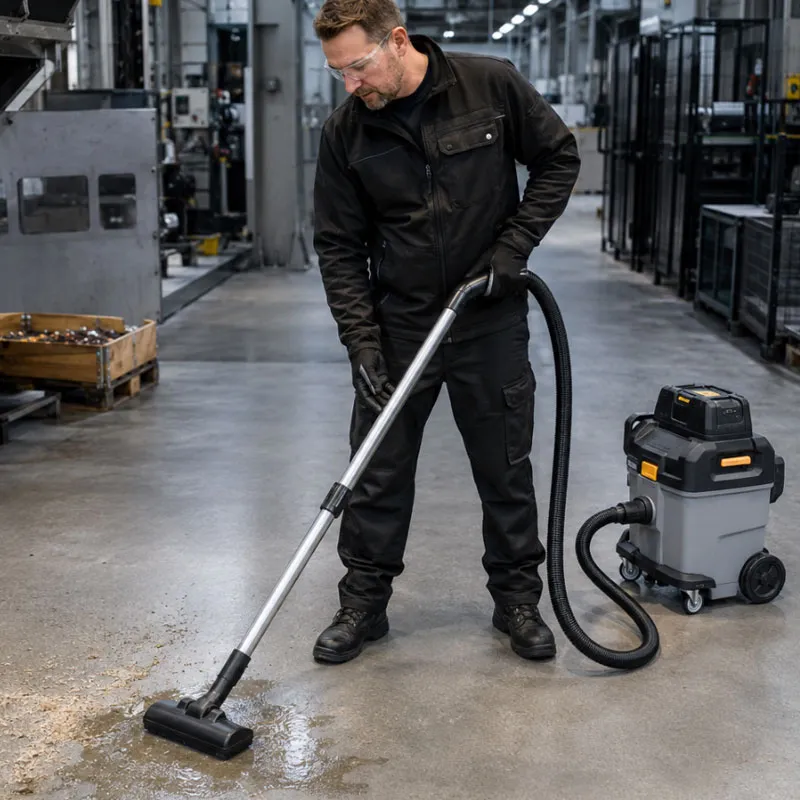
Battery models are also practical for mixed housekeeping. An operator may encounter dry dust in one zone, packaging residue in another and a small liquid spill elsewhere. If the machine is configured for wet and dry use, one mobile unit can cover the entire route.
A battery powered industrial vacuum cleaner offers greater deployment freedom, while a corded machine usually provides unlimited runtime whenever a suitable power source is available.
This comparison should not be reduced to “cordless is better” or “corded is stronger.” The correct answer depends on the job.
A corded industrial vacuum can perform extremely well when cleaning takes place in one fixed zone. However, when the operator must move through a large warehouse or several production cells, cable handling begins to consume time.
A cordless machine removes that barrier, but the facility must then manage charging and practical runtime. The correct choice therefore depends on whether mobility or continuous operation has the greater operational value.
| Factor | Battery Powered Industrial Vacuum Cleaner | Corded Industrial Vacuum |
|---|---|---|
| Mobility | Excellent for changing routes | Limited by cable and socket access |
| Runtime | Limited by battery capacity | Continuous with mains power |
| Setup | Fast deployment | Requires cable management |
| Best environment | Warehouses, maintenance and mobile cleaning | Fixed work areas and continuous cleaning |
| Planning requirement | Charging workflow | Power and cable routing |
A battery powered industrial vacuum cleaner should be evaluated by runtime, airflow, vacuum level and collection capacity together because no single figure gives a complete picture of real-world performance.
Using Waidr’s WD-100 series as an example, the machine uses a 24 V system with 1.5 kW power, approximately 351 m³/h airflow, up to 370 mbar vacuum and a 100 L collection container. Stated operating time is approximately 2.5 to 3.5 hours per full charge.
Each number answers a different question. Airflow indicates how much air the vacuum can move. Vacuum level reflects pickup force under resistance. Collection volume determines how frequently the operator needs to stop and empty the machine. Runtime tells the facility how many routes or work zones may be completed between charges.
For a 90-minute route, 2.5 to 3.5 hours may cover more than one cleaning cycle. For a near-continuous eight-hour process, the same machine may not be the correct choice.
Buyers should therefore convert specifications into route logic rather than comparing numbers in isolation.
A battery powered industrial vacuum cleaner should be matched to the actual cleaned area rather than the total building size.
A 10,000 m² factory may only require 2,500 m² of focused daily cleaning. Conversely, a smaller facility may require repeated cleaning through every shift and therefore place greater demand on the battery system.
The easiest method is to divide the cleaning route into zones and record how long each zone takes. Then estimate the amount and type of material collected during each route.
At this stage, buyers should also decide whether several departments will share the machine. A vacuum that is adequate for one warehouse team may be used much more heavily if maintenance, production and logistics all rely on it during the same shift.
Where the commercial intent is already visible in keyword data, the article should guide readers toward the dedicated battery powered industrial vacuum cleaner product page so the informational content strengthens, rather than competes with, the target landing page.
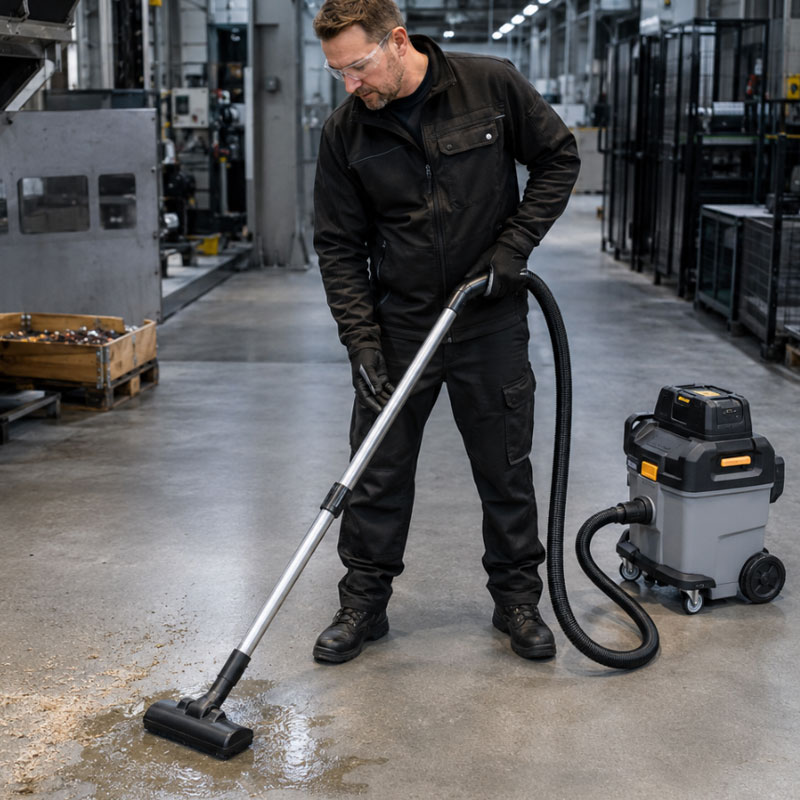
A battery powered industrial vacuum cleaner is particularly useful for mixed wet and dry cleaning when operators must respond quickly across changing work areas.
Industrial facilities rarely generate only one residue. A warehouse may need dry dust collection in one aisle and liquid recovery near a loading area. A maintenance team may clean machining residue in the morning and handle a spill later in the shift.
In those situations, cable-free mobility becomes especially useful because emergency cleanup often happens in inconvenient locations.
However, buyers should still verify whether the intended machine is designed for the material and liquid involved. Wet and dry capability depends on the collection and separation design, not simply on the fact that the vacuum uses a battery.
A battery powered industrial vacuum cleaner succeeds operationally only when the facility has a simple and reliable charging routine.
This is one of the most overlooked aspects of cordless equipment. A high-performance machine provides little value when the next shift discovers that the battery was not recharged.
The facility should define who connects the machine to the charger, where the charging station is located and at what point in the shift charging normally begins.
Many plants align charging with natural downtime such as the end of the evening cleaning route, a scheduled maintenance period or a production break.
Where one unit must support multiple teams, the buyer should also consider whether the charging window is long enough to serve everyone reliably.
A battery powered industrial vacuum cleaner can improve ergonomics by reducing cable drag, but safe operation still depends on matching the machine to the collected material and work environment.
Removing extension cords from aisles can reduce trip exposure and make movement around pallets, machinery and production cells easier. Operators can change direction without continuously repositioning a cable.
Battery power, however, does not automatically make a vacuum suitable for hazardous dust. Where combustible powders or classified environments are involved, buyers need to evaluate specialized equipment rather than ordinary cordless cleaners.
For these applications, Waidr can separately evaluate atex approved vacuum cleaners and other model-specific hazardous-area configurations.
A battery powered industrial vacuum cleaner generates return primarily through labor savings, faster response and easier deployment.
Suppose a corded cleaning route takes 100 minutes per shift, including 15 minutes spent finding sockets, repositioning cables and moving between zones. If a cordless machine reduces the same route to 85 minutes, the facility saves 15 minutes per shift.
Across 250 working days, that equals 3,750 minutes, or approximately 62.5 labor hours per year. In a multi-shift facility, the potential saving increases further.
This example is deliberately simple, but it demonstrates the right way to evaluate cordless equipment. The value is not only in suction. It is in the time that no longer needs to be spent managing the machine.
Waidr therefore recommends measuring current route time before purchase. That gives the facility a baseline for evaluating whether the equipment actually delivers the expected improvement.
A battery powered industrial vacuum cleaner is not always the best choice when the application requires long-duration continuous duty, very high power or a fixed process connection.
If a vacuum must run for extended periods at one production point, a three-phase machine can offer a more suitable operating profile.
For example, Waidr’s compact three-phase range includes approximately 2.2 kW, 3.0 kW and 4.0 kW configurations with airflow up to around 420 m³/h. For continuous industrial use where mobility is less important, a 3 phase vacuum cleaner may provide a better long-term fit.
Likewise, a facility with one fixed cleaning station and convenient mains power may gain little from introducing batteries.
The correct selection is therefore application-led rather than technology-led.
A battery powered industrial vacuum cleaner is often mis-purchased when buyers focus on cordless convenience but overlook route duration, waste characteristics and charging responsibility.
The first mistake is assuming cordless automatically means more productive. It does not if the cleaning cycle is longer than the usable runtime.
The second mistake is ignoring debris type. Fine dust, chips, liquids and bulky packaging residue all place different demands on the vacuum.
The third mistake is purchasing without considering accessories. Narrow machines, production equipment and difficult corners may require different tools or hose lengths.
Another mistake is comparing true industrial machines with lightweight commercial vacuums. Industrial environments typically require stronger construction, higher collection capacity and more stable performance over longer cleaning cycles.
A battery powered industrial vacuum cleaner is easier to specify when the buyer answers a short list of operational questions before requesting a quotation.
How long does the current cleaning route take? How many plug changes occur? What material is collected? Is liquid recovery required? Who will charge the machine? Where will it be stored? What improvement would make the purchase successful?
These questions create a much more useful purchasing brief. Instead of asking for “a powerful battery vacuum,” the facility can request a machine that must complete a particular route, handle a defined waste profile and remain usable for a known period.
Waidr uses this application-led approach because industrial buyers need a solution matched to workflow rather than generic cordless marketing.
Waidr selects a battery powered industrial vacuum cleaner by reviewing route length, waste type, runtime expectation, wet or dry requirements and available charging conditions before recommending the final model.
The most useful inquiry includes the size of the actual cleaning area, material type, desired operating time, frequency of use and any liquid-recovery requirement.
With those details, the Waidr team can determine whether a WD-100 series configuration is appropriate or whether another industrial vacuum architecture would deliver better performance.
Clear decision logic also helps content perform in Google AI Overview and other generative search systems. AI platforms can more easily extract and cite a section that clearly defines when cordless industrial equipment is appropriate and which measurable criteria should be checked.
A battery powered industrial vacuum cleaner FAQ should answer the practical questions that affect route planning and purchase confidence.
Runtime depends on the model and operating mode. Waidr’s WD-100 series states approximately 2.5 to 3.5 hours of operation per full charge.
Not necessarily. Industrial cordless equipment can provide strong airflow and vacuum. The correct comparison should include both cleaning performance and route efficiency.
Yes, when the model is designed for wet and dry recovery. The collection and separation configuration should still be confirmed for the material.
The main reason is mobility. Operators can move through large or changing areas without repeatedly reconnecting power cables.
Three-phase systems are generally more suitable for longer-duration continuous cleaning or fixed industrial duties where runtime matters more than mobility.
Provide the cleaning area, waste type, wet or dry requirement, expected runtime and charging conditions.
A battery powered industrial vacuum cleaner creates the greatest value when mobility is the hidden productivity problem. If workers spend unnecessary time moving cables, searching for sockets or crossing large facilities between cleaning zones, cordless industrial equipment can shorten the route without changing the cleaning objective.
The best buying method is to translate specifications into real workflow: how long the route takes, how much waste is collected, how frequently the machine moves and whether charging can be managed reliably.
Waidr helps industrial buyers evaluate those conditions before choosing the final model. Request a model recommendation if your facility needs a cordless vacuum configuration based on actual runtime, waste and working-area requirements.