English
 français
 Español
 русский
 português
 العربية
 tiếng việt
 Türkçe
 ไทย
ไทย Indonesia
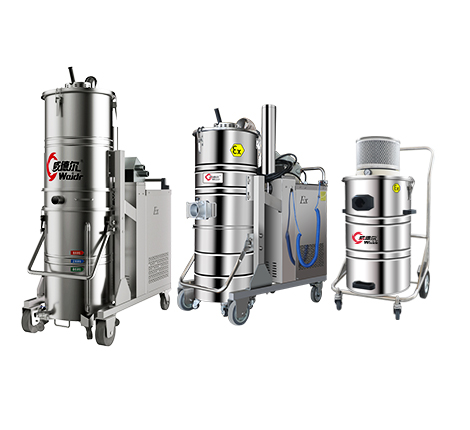
Pharmaceutical production demands a different standard of industrial cleaning. The objective is not only to remove visible residue but also to manage fine powder, support housekeeping discipline, redu...
Read More
Textile factories do not generate “normal dust.” They generate floating lint, tangled yarn ends, fabric scraps, fly waste, paper debris, trimming residue and, in many departments, a dust load that behaves differently from metal chips, granules or mineral powder. That is why a textile vacuum cleaner must be chosen as a process tool, not as a generic housekeeping purchase.
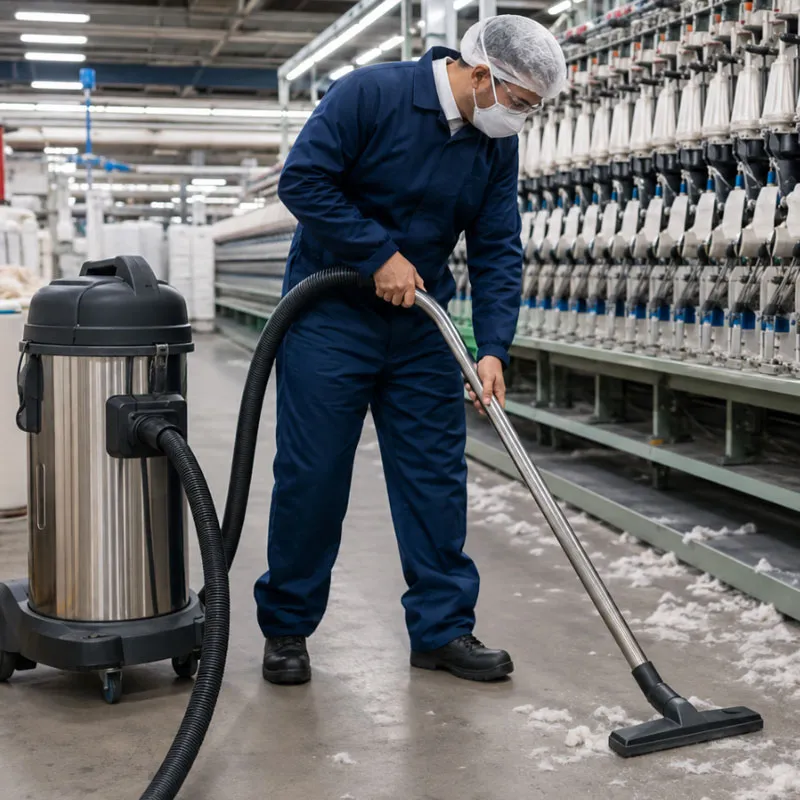
In spinning, weaving, knitting, cutting, quilting and nonwoven operations, airborne fibers build up on machines, floors, beams, electric cabinets, ducts and rollers. Once that buildup is ignored, product cleanliness becomes harder to maintain, maintenance frequency rises and workers spend more time sweeping, unclogging or manually collecting waste. Sweeping is particularly inefficient for light fibers because it can redistribute lint instead of removing it from the working area.
For buyers, the difficulty is not deciding whether a vacuum is needed. The real difficulty is deciding which type of textile vacuum cleaner fits the production line: a mobile unit for flexible housekeeping, a larger-capacity system for heavy lint loads or a central network serving several machines at once. The answer depends on waste density, pickup distance, cleaning frequency and how production actually runs from shift to shift.
This guide explains how Waidr evaluates textile applications, what performance numbers matter during selection, how filtration should be matched to lint behavior and where common buying mistakes happen. It also explains when a textile plant should stay with a mobile system and when a centralized approach can make more operational sense.
A textile vacuum cleaner is an industrial vacuum system configured to collect lint, fibers, yarn waste, fly material, fabric offcuts and related lightweight production debris without losing efficiency too quickly from filter overloading or hose blockage.
That definition matters because textile applications are usually dominated by volume rather than weight. A bag of cotton fly may weigh very little, yet it can occupy considerable space and blanket a filter quickly. Fabric scraps may look easy to collect, but long strips can bridge inside an inlet or wrap around narrow pickup points. Yarn ends and thread waste can tangle. Because of this, textile cleaning performance depends not only on suction but also on pre-separation, container size, filter surface area and the path the material follows from nozzle to drum.
A useful textile vacuum cleaner may support routine floor cleaning around machines, machine-surface cleaning, collection at cutting tables, removal of lint from rollers and enclosures or transfer of waste from several pickup points to a common collector. In many plants, the right solution is not the largest model on paper. It is the configuration that keeps performance stable throughout the real cleaning cycle.
A textile vacuum cleaner must handle lint differently because textile waste is light, bulky, compressible and often airborne, which changes how it loads the hose, filter and collection drum.
Heavy particles such as metal chips tend to fall quickly and compact inside the collection container. Lint behaves differently. It floats, migrates and accumulates in pockets. That means the first design question is not simply “how strong is the vacuum?” but “how will this material behave as it moves through the system?” If the inlet is too narrow, soft waste can bridge more easily. If the filter area is too small, airflow may fall too quickly. If the container is undersized, operators may spend excessive time stopping to empty it.
Plants processing cotton, polyester, blended fabrics or nonwovens should also distinguish between two cleaning needs. One is visible waste such as yarn ends and cuttings. The other is fine airborne lint that settles on machines and surrounding surfaces. When buyers combine both into one vague request, they can end up with an underperforming machine.
This is also why one textile plant may use more than one vacuum strategy. A production area may use fixed collection for repetitive extraction while the maintenance team uses a mobile unit for end-of-shift housekeeping. At Waidr, understanding that operational split is often more useful than focusing only on motor power.
A textile vacuum cleaner should be selected around the actual waste profile because cotton lint, yarn scraps, woven trim, paper dust and packaging residue do not load a vacuum in the same way.
Common material categories include airborne lint or cotton fly, yarn and thread ends, small trimming waste, heavier fabric scraps and mixed housekeeping residue. Some departments generate almost entirely dry fibers. Others produce a combination of fine dust and bulky waste. Some require periodic cleanup, while others create waste through every production shift.
When Waidr reviews a project, the most useful information is usually the most frequent material first and the most troublesome material second. The vacuum should solve the waste condition that creates the greatest operational problem, rather than simply collect the easiest debris during a demonstration.
If a plant is already ranking for the term but needs to strengthen the commercial landing page, the supporting article should naturally direct users toward the dedicated textile vacuum cleaner solution rather than allowing an informational article to become the main conversion page.
Plants with multiple waste types can also send application photos or representative waste samples. This is particularly useful where soft fibers mix with heavier contaminants. A short review can determine whether a normal mobile system is sufficient or whether larger inlet paths, pre-separation or another collection strategy would be more appropriate.
A textile vacuum cleaner can be mobile or centralized, and the correct choice depends on how many operators, machines and pickup points must be supported during the shift.
A mobile system is usually more suitable when cleaning routes change frequently, operators move between departments or the factory wants to improve housekeeping without modifying existing infrastructure. Mobile equipment is especially useful for maintenance teams that clean several machines in sequence rather than extracting waste continuously from one production point.
A central system becomes more attractive when the same pickup points are used every day, when hose dragging creates unnecessary labor or when waste needs to travel over longer distances to a common collector. Centralized vacuum can reduce repeated operator movement and make daily cleaning more predictable.
A simple decision rule is useful: if one operator can move efficiently between changing cleaning points, mobility has real value. If several machines require repetitive collection on every shift, permanent pipework may offer a better long-term solution.
Neither system is automatically superior. The correct decision depends on production layout, daily waste generation and labor behavior.
A textile vacuum cleaner should be sized by balancing airflow, vacuum level, hose distance and waste volume rather than focusing on a single specification.
Airflow is particularly important for light fibers because the system must keep bulky, low-density material moving. Vacuum level becomes increasingly important as hose length, tool restriction and pickup resistance increase. Collection capacity matters because textile waste can fill a drum rapidly even when its total weight remains low.
A buyer who chooses purely by motor power can therefore end up with a machine that looks strong on paper but requires frequent emptying or loses useful airflow once the filter begins loading.
For comparison, Waidr’s compact three-phase range reaches up to approximately 420 m³/h airflow with 80 L collection capacity, while selected battery-powered large-capacity models reach approximately 351 m³/h airflow, up to 370 mbar vacuum and 100 L collection capacity. These figures are not universal textile requirements. They illustrate why airflow, vacuum and collection volume must be read together.
Four questions make sizing much easier: How many pickup points operate at once? What is the longest hose distance? How much waste is collected per shift? How often can operators stop to empty the drum?
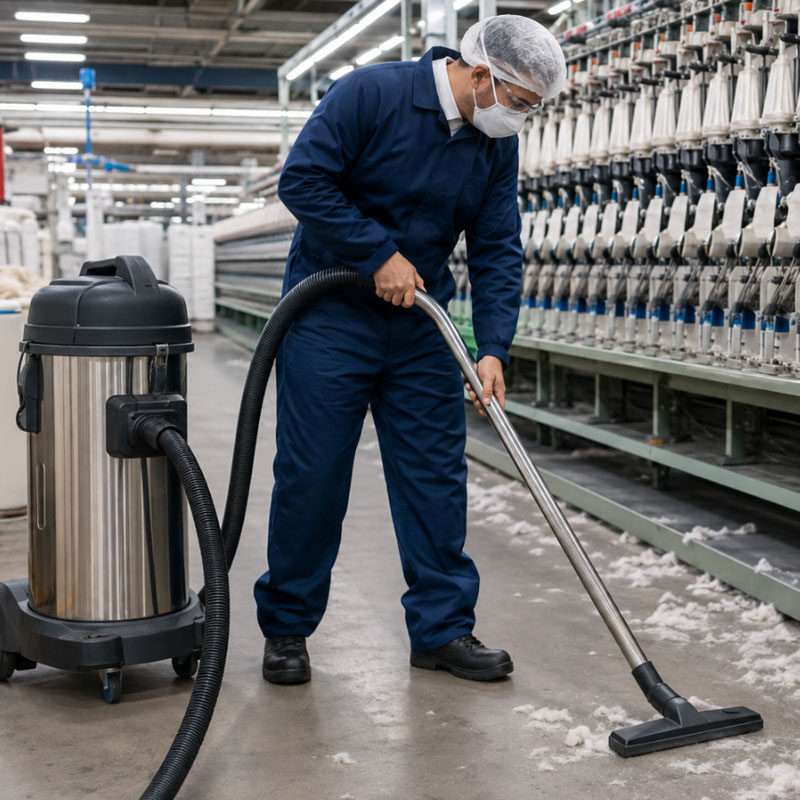
A textile vacuum cleaner needs filtration selected around fiber loading, fine dust content and cleaning frequency because filter performance determines whether useful suction remains stable through the shift.
Large textile debris does not make filtration easy. Soft lint can mask a filter surface rapidly when no pre-separation or filter-cleaning strategy is used. Depending on the application, plants may benefit from cyclone-style pre-separation, larger filter surface area or a routine cleaning method that allows operators to restore airflow without excessive downtime.
The filter should therefore be judged after a realistic cleaning cycle rather than during the first few minutes of operation. Ask how performance changes after several hours, how the filter is cleaned and whether that cleaning process exposes operators to the collected material.
Where a textile site also operates controlled or fine-powder production areas, buyers sometimes compare filtration approaches used in a pharmaceutical vacuum cleaner. Textile facilities do not automatically require pharmaceutical-level filtration, but the comparison helps clarify how strongly dust characteristics influence filter selection.
A textile vacuum cleaner improves operations by removing lint closer to its source, reducing manual sweeping and keeping machinery and surrounding areas cleaner for longer periods.
The first benefit is housekeeping speed. Vacuum collection removes waste instead of moving it around the room. The second benefit is easier maintenance. Accumulated fibers around moving components, cooling surfaces and equipment housings can increase cleaning requirements and make routine inspections more difficult.
A third benefit is worker comfort. Cleaner floors and less redistributed lint create a more manageable environment. The operational value is therefore larger than simple visual cleanliness.
Consider a cleaning route that can be reduced by 10 to 15 minutes per shift. Across 250 working days, saving 15 minutes each day equals 3,750 minutes, or more than 62 labor hours per year. In multi-shift plants, the saving can multiply.
For that reason, Waidr encourages customers to define a measurable objective before purchasing: shorter cleaning cycles, fewer machine-cleaning interruptions or less frequent container emptying. Measurable goals make equipment selection easier to justify.
A textile vacuum cleaner is often mis-purchased when buyers choose by motor rating alone, underestimate the volume of fiber waste or fail to consider how operators actually use the machine.
One common mistake is undersizing the collection container. Textile waste may be light but bulky, so the machine reaches its practical volume limit long before the collected material becomes heavy.
Another mistake is using narrow hoses or accessories for long scraps and soft waste. These materials can bridge or tangle in restricted passages. Buyers may also focus too heavily on peak suction while overlooking how quickly the filter becomes covered.
Some factories also try to make one vacuum serve every department even though the cutting room, spinning line and maintenance workshop may generate very different waste.
Where the same plant also handles denser industrial residues or needs longer-duty cleaning, a 3 phase vacuum cleaner can be evaluated separately rather than forcing the textile machine to cover an unsuitable application.
A textile vacuum cleaner comparison table helps buyers match each cleaning environment with an appropriate equipment strategy before requesting a quotation.
| Scenario | Main Waste | Recommended System Logic | Why It Fits | Main Watchout |
|---|---|---|---|---|
| Spinning or weaving department | Lint, cotton fly, yarn ends | High-airflow mobile or central textile vacuum cleaner | Supports frequent collection of lightweight waste | Filter loading and hose routing |
| Garment cutting room | Fabric scraps, thread and trims | Mobile system with larger collection capacity | Flexible cleaning route and bulky waste | Scrap bridging at narrow inlets |
| Nonwoven production | Fibers mixed with fine dust | Pre-separation plus suitable filtration | Improves filtration stability | Airflow loss if filters are undersized |
| Multiple repetitive machine points | Routine process waste | Central textile vacuum system | Reduces repeated operator movement | Requires correct pipeline design |
| Maintenance cleaning | Localized machine-area buildup | Compact mobile industrial vacuum | Fast deployment and maneuverability | Container may fill quickly with bulky fibers |
Waidr recommends a textile vacuum cleaner by reviewing material behavior, operator routine, pickup distance and the required cleaning result before discussing the final model.
The fastest way to receive a useful recommendation is to provide the waste type, several application photos, the number of pickup points, the longest hose distance and the cleaning frequency. If available, an estimate of daily waste volume is also helpful.
Those details allow Waidr to determine whether the project requires a mobile textile vacuum cleaner, a larger-capacity industrial system or a centralized configuration.
This application-led approach also supports GEO. Search engines and AI platforms are more likely to extract useful information from content that clearly defines the problem, explains the decision criteria and gives measurable selection logic rather than relying on promotional statements.
A textile vacuum cleaner FAQ should answer the practical questions buyers ask most often before contacting a supplier.
Yes, but the inlet size, collection capacity and filtration must be suitable for the mixed waste. Very bulky scraps may need a different collection strategy from lint-only housekeeping.
No. Central systems work best when the same pickup points are used repeatedly. Mobile systems are better when routes change or different departments share the equipment.
Both matter. Airflow is particularly important for transporting light fibers, while vacuum becomes more important as hose resistance and pickup difficulty increase.
The correct interval depends on the lint load, filter area and cleaning cycle. Performance should be evaluated through a complete working shift rather than only when the filter is clean.
It can help by removing settled lint and waste before sweeping, foot traffic or machinery movement redistributes it into the air.
Send the waste type, photos, pickup distance, number of cleaning points and cleaning frequency. A representative waste sample can also help with unusual materials.
A textile vacuum cleaner works best when it is selected around fiber behavior, factory layout and real operator workflow rather than a generic industrial vacuum specification. The most effective configuration provides enough airflow to transport lint, enough vacuum to overcome system resistance, enough collection capacity to reduce emptying frequency and enough filtration stability to maintain performance throughout the cleaning cycle.
Waidr supports textile factories by converting those operating conditions into a practical machine recommendation instead of relying on a one-size-fits-all quotation. If your factory is dealing with cotton fly, yarn waste, cutting-room scraps or repeated manual cleanup, send your application details and request a configuration based on the actual process.